

Antifragile is a concept developed by Nassim Nicholas Taleb, a former trader and risk analyst. His work focuses on how systems behave when conditions are uncertain, volatile, or difficult.
He noticed that much thinking tends to fall into two camps.
- Things that break under stress.
- Things that resist stress and stay the same.
He suggested a third option – antifragile.

Something antifragile doesn’t just survive disruption; it actually improves because the disruption exists.
Taleb developed this idea by studying complex systems, particularly in economics, finance, and policy, where things can look perfectly fine on paper but fall apart when conditions change.
In many cases, relatively small changes were enough to expose weaknesses that only became obvious once pressure was applied – and only then did things start to unravel.
Examples:
- A business model that worked well until it unexpectedly didn’t.
- A perfectly sensible decision that later became the wrong one.
- A long-awaited upgrade that optimised the totally wrong thing.
For example, Blockbuster pooh-poohed Netflix in 2000, treating its online, subscription-based model as too niche to matter at the time. Netflix later went on to dominate the market as consumer behaviour shifted.
Coca-Cola spent millions developing a new-and-improved recipe nobody wanted. Turns out, people wanted what they expected. Who knew?
These decisions were not stupid.
They were logical, defensible, and data-backed… at the time.
The problem was that they were tested mainly in calm conditions, or only in theory.
Why it matters
A lot of modern burnout, over-engineering, and everyday overwhelm comes from systems that only work when nothing unexpected happens.
Most of modern life is organised around reducing friction.
- We smooth.
- We optimise.
- We protect.
- We streamline.
That works beautifully when the world behaves itself. (Can you imagine?)
The problem is that systems designed for perfect conditions tend to be brittle. They cope well when everything is predictable and struggle the moment novelty, pressure, or uncertainty is introduced..
Antifragile thinking means asking different questions.
Instead of:
“How do I avoid stress?”
It asks:
“Which kinds of stress make this better, and which kinds cause damage?”
The aim is not toughness for its own sake.
Go hard or go home.
No carbs before Marbs.
No rest for the wicked.
No sleep till Brooklyn.
Antifragile design benefits from challenge rather than being undone by it.
And that applies whether it’s a billion-pound product, a wedding or a family schedule.
Everyday examples
The human body improves because load is applied and then removed. #Gainzbrah. Muscles, bones, and cardiovascular systems all adapt through controlled stress followed by recovery.
Confidence grows through small, repeated exposures (phew, survived that!), not dramatic leaps. Speaking up once, then again. Trying something slightly uncomfortable, then noticing you survived.
Skills improve when feedback is regular and specific rather than rare and overwhelming. How dare they.
Learning thrives on iteration, not perfection.
In each case, the growth comes from manageable ‘variability’. Enough to nudge things a little further, then to adapt.
Not so much that the system (or you) collapses.
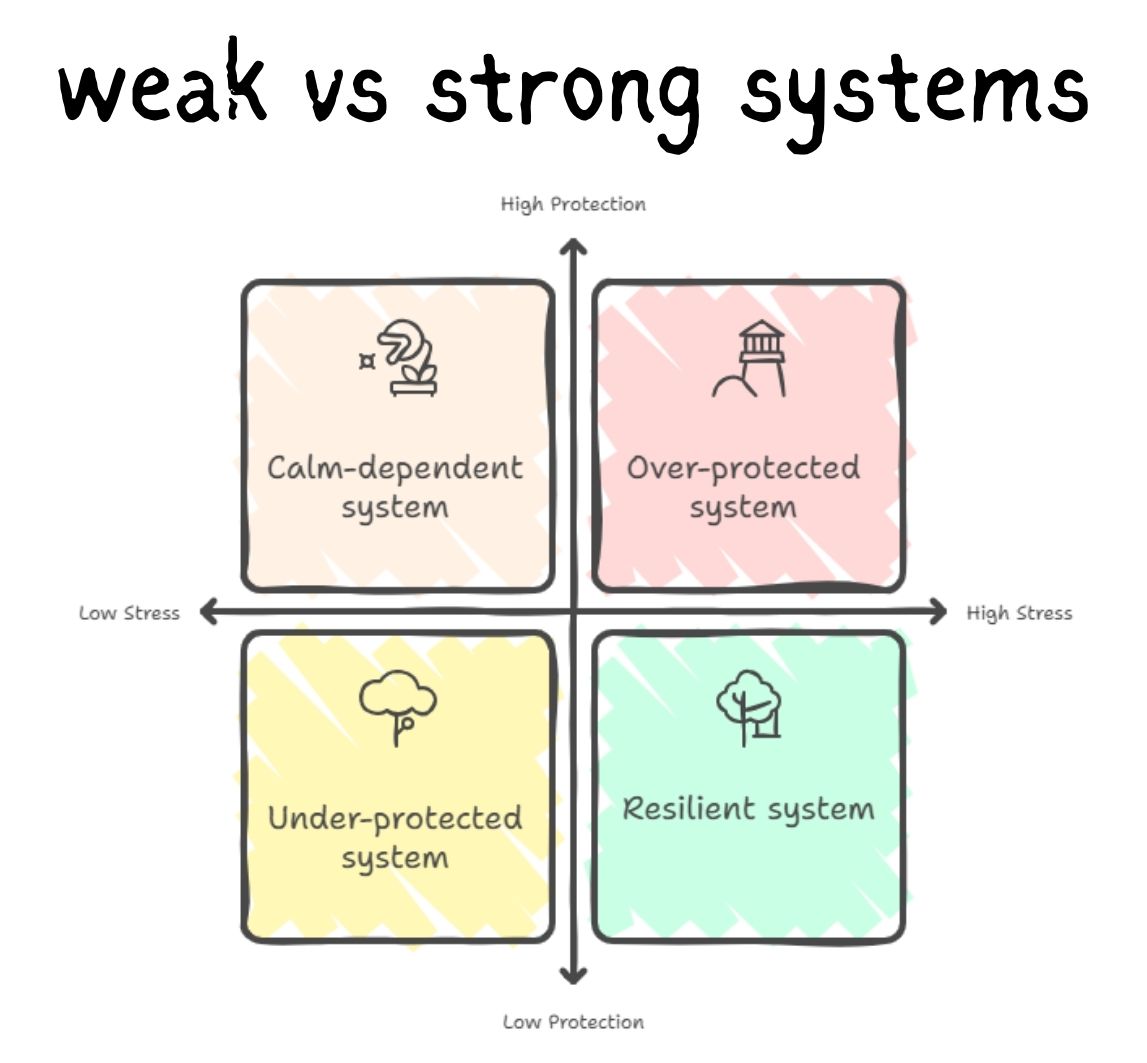
That balance is the key.
What antifragility is not
Antifragile does not mean throwing yourself into the deep end and hoping for the best.
Nor does it mean trauma builds character, that all pressure is good pressure, or that more is better, as certain corners of the internet would suggest.
Poorly designed stress can absolutely be detrimental.
Well-designed stress teaches like nothing else.
The most useful skill to develop, is working out which is which.
Try this today
Look at one area of your work or life that only functions when conditions are calm.
Ask yourself:
- Where does this start to go sideways?
- What small stress already shows me the weak point?
- What low-risk experiment would make this a bit sturdier?
- Where am I over-protecting instead of learning?
Keep it modest.
Going berserk is rarely the right approach. In my experience, anyway.
Antifragile gains come from small inputs (experiments, contingencies, little acts of courage) repeated over time, not heroic overhauls.
Some things to think about
Comfort is not the same as safety, even though it can feel like it.
Removing every source of friction can make life pleasant in the short term and fragile in the long term. The useful question is not whether discomfort exists, but whether it is doing anything constructive.
The goal is not to seek hardship.
(I had an extremely Catholic Nan might have argued with you on that one, but the principle stands.)
It is to avoid designing a life that can only cope when nothing goes wrong.
Optional challenge
Choose one deliberately uncomfortable but safe action this week.
- Say the thing you usually pussy-foot around.
- Ask for the feedback you usually duck out of.
- Try the slightly harder version rather than the easier one.
Then notice what improves.
A Buddh-ish take
“Fire does not burn fire.”
– Dhammapada
Difficulty only overwhelms us when we have no internal structure to meet it.
What changes us is not the challenge itself, but how it meets what we have already built inside.
Back to Mindset Mechanics <
Back to The Vault <
References
References
Taleb, N. N. (2012). Antifragile: Things That Gain from Disorder. Random House.
Satell, G. (2014). “What Blockbuster Really Missed About Netflix.” Forbes.
Schlitz, G. (2016). “The New Coke Story.” Smithsonian Magazine.
McEwen, B. S. (1998). “Stress, Adaptation, and Disease.” Annals of the New York Academy of Sciences.