Win at Life

Attachment Styles
Definition
Attachment style refers to the way we connect, trust, and respond to closeness in relationships. It is formed by our earliest bonds but can change over time.
It’s the blueprint that quietly runs in the background when we love, parent, and lead. It even shows itself when we start to get angsty waiting for a WhatsApp message reply.
UK psychologists John Bowlby and Mary Ainsworth first explored attachment in the 1950s and 1960s by researching how babies form bonds with their caregivers. Later, in the US, Cindy Hazan and Phillip Shaver looked at how the same patterns can be seen in adult life – in friendships, relationships, and even at work.
Attachment is not the same as dependence or neediness. It is about how secure we feel in connection and how we respond when that sense of security is threatened.
It’s also worth knowing that attachment style isn’t a single, fixed label. You might feel secure with one person and anxious with another, depending on the level of trust, communication, and emotional safety.
The pattern is most obvious when something is important and matters to you.
What it is
Your attachment style is your internal guide for relationships. It shapes how you approach closeness and respond to others, often unconsciously.
For example, when someone tries to get close emotionally – or even just in conversation, do you lean in, tense up, or brace for impact?
Do you need a moment to think, or are you immediately all-in, feet-first?
Do you pull away when things feel too intense, or find yourself checking whether people still care (or second-guessing that?)
Those reactions often have more to do with the model your nervous system built years ago than with who’s in front of you or what they are doing.
It’s worth knowing that this isn’t a right-or-wrong, who’s-to-blame issue, but being aware of it can be really helpful in your relationships.
When we understand our particular pattern, we can see it coming and work with it, rather than being run by it.
Healthy connection isn’t a competition sport – being perfectly attached is more of an ongoing goal. The work is in noticing when your old wiring starts calling the shots and realising you can do things differently.
The four attachment styles
1. Secure
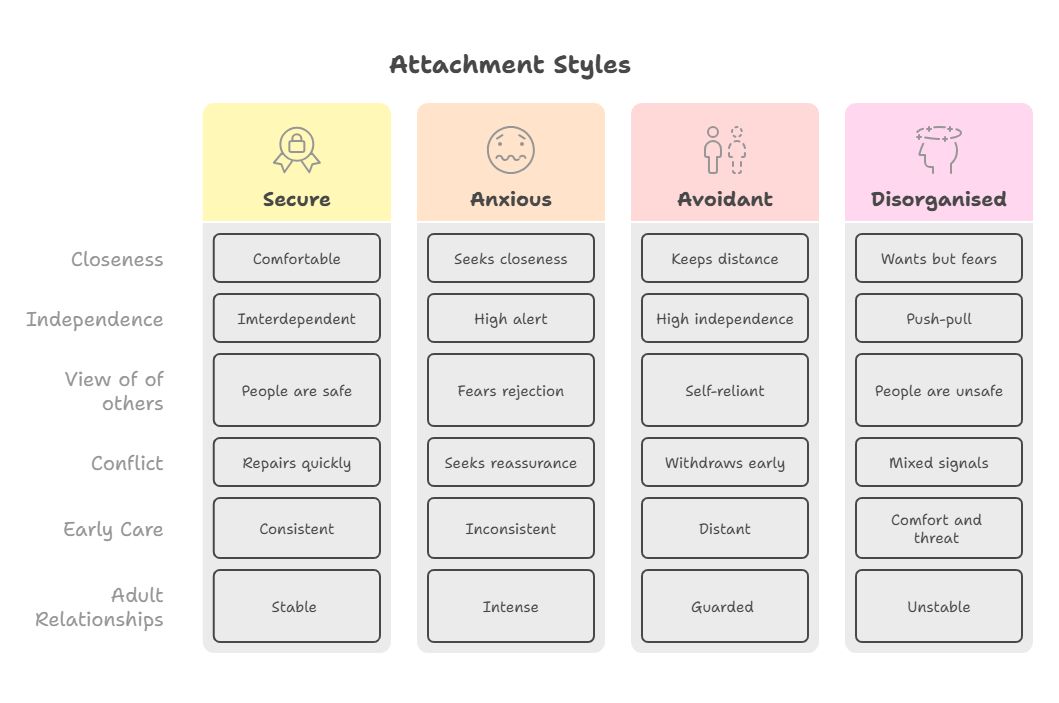
This is the gold-star, grown-up, well-balanced standard of connection. People with secure attachment are comfortable being close yet independent. They are happy to depend on others and be depended on.
They assume that people’s intentions are generally good, and they move on quickly from arguments and conflict. They don’t freak out about silence or space, or interpret it as rejection. Their early caregivers were usually responsive and consistent, producing a sense of “the world is safe, and so am I.”
In adult life, that tends to translate into confidence, sensible boundaries, and healthy, happy relationships.
2. Anxious (or preoccupied)
Anxious types crave intimacy but can be on high alert – worrying that it won’t last. They tend to read between the lines and replay conversations in their heads. This is the attachment style that will double-text when someone doesn’t reply quickly enough.
They can create entire imaginary relationship subplots that feel real.
They can be labelled “too much”, “a lot” or “full on”. What drives this is a nervous system desperately trying to find reassurance.
Early experiences may have been inconsistent; love and caregivers’ moods swung unpredictably. They learned to stay alert for signs the connection might slip away.
Anxious attachment can bring passion, empathy, and loyalty, but it can also exhaust everyone if driven by fear. (I feel so seen…)
Screen/Literary Examples: Bridget Jones, Ross from Friends, Romeo, and Cathy Earnshaw from Wuthering Heights.
3. Avoidant (or dismissive)
Avoidant types value independence above all else. They’re often seen as self-sufficient, cool and calm.
Underneath that composure is an unease or discomfort with relying on others or being relied upon. They far prefer to do things for themselves than ask for help.
In childhood, care may have been practical, non-existent, or emotionally distant. As adults, getting close feels risky, even suffocating.
They prefer control, keep their feelings private, and sometimes retreat when things get serious. It can land as arrogance or coldness, but in reality, it’s just self-protection.
Avoidant people aren’t avoiding you; they’re avoiding the vulnerability that dependence represents. (Which can feel a bit hurtful, if you don’t expect it.)
Screen/Literary Examples: Shane (L-Word), Dr House, James Bond, Batman. It would seem that avoidant types are often the sexy ones. It’s not just me, is it?
4. Disorganised (or fearful-avoidant)
This one is often the trickiest for others to navigate.
It mixes the push-pull of both anxious and avoidant. People with this style often want connection but are terrified of it at the same time.
Their early environment may have involved both comfort and threat, the same person being the source of love and stress.
That confusion wires in a confusing kind of ambivalence: “come closer… but don’t hurt me.”
For adults, it can look like intensity followed by retreat, or closeness followed by self-sabotage. It’s rarely intentional, just instinct clashing with desire.
Screen/Literary Examples: Fleabag, Will Hunting, BoJack Horseman, and Shiv Roy. They tend to be the compelling ones. Probably a bit of a nightmare, but excellent television.
Real-life patterns
In romantic relationships
Couples who are secure tend to talk openly, argue fairly, and recover from their disagreements quickly.
Anxious and avoidant couples often dance a “chase and retreat” pattern, one pursues, the other distances, both feeling misunderstood.
Disorganised dynamics can feel like fireworks: exciting, unpredictable, sometimes stormy – even to the point of ending things.
In friendships
Secure friends are consistent.
They don’t vanish mid-conversation or panic if a text goes unanswered.
Anxious friends worry about being a burden or forgotten.
Avoidant friends prefer fewer, looser ties. You might not hear from them often, but when you do, it’s like no time had gone by at all.
Disorganised friends crave closeness yet keep their guard up and change plans at the last minute. They might confusingly swing between excitedly oversharing one day and ghosting the next.
Leadership at Work
A secure manager trusts people enough to delegate tasks.
An anxious one micromanages people.
An avoidant leader may withdraw or delegate tasks that involve conflict or feedback.
A disorganised one might alternate between intense involvement and sudden disengagement, and then nowhere to be seen.
Recognising these patterns isn’t about labelling people.
It’s about noticing what drives your reactions under pressure and understanding why other people might be acting a certain way.
(That said, I expect you’ve thought about which cap would fit certain people)
Why it’s a useful model
What makes attachment theory genuinely useful is that it shifts the question from “what the heck is wrong with this person?” to “what attachment pattern does this look like, and how could I meet them in a more effective place?”
It’s like an X-ray lens for understanding conflict.
A lot of what looks like stubbornness, neediness, or emotional unavailability makes more sense when you can identify the attachment pattern underneath it.
This also explains why the same person behaves differently in different relationships, depending on the level of safety they feel with each individual.
Research suggests that styles aren’t fixed.
People do shift – often through secure relationships, therapy, or just becoming more conscious and in tune with their own patterns.
It takes some work, but it’s a more hopeful picture than the idea that a difficult childhood has ruined your life.
Things To Think About
- Which attachment pattern sounds most like you when you feel threatened or rejected?
- What is your attachment default when you’re under stress?
- Who in your life helps you feel safe enough to relax and be open and honest?
- Do you tend to pursue, withdraw, or freeze when things get intense?
Optional challenge
This week, work out where you could practice secure behaviour, even if you don’t feel it yet.
If you are normally the ‘chaser’, the text-first, maker-of-arrangements, take a breath first before picking up the phone and reassure yourself.
If you usually run for the hills when things get close, try to stay present through one uncomfortable conversation.
If you flip between both, take a breath before reacting and ask: “What would a secure person do right now?”
Tiny repetitions are the key to building new wiring.
Every small repair is a ‘sculpting’ moment.
A Buddh-ish take
This is a big issue in Buddhism.
Attachment, in Buddhist psychology, is often seen as the source of all suffering: clinging, craving, grasping. But there’s an important distinction between attachment to and attachment with.
The first binds you.
The second connects.
Healthy attachment isn’t about possession; it’s about your presence.
When we connect from a place of safety (rather than scarcity), we stop chasing or avoiding.
We simply meet one another.
And while I usually end these with a quote from the Dhammapada, it felt right here to borrow from the poet Rumi, who captured this one a bit more gently.
“Love is the bridge between you and everything.”
Real connection is not being fear-free.
It’s choosing to stay, listen, and soften, even when the scared part of you whispers otherwise.
Back to Mindset Mechanics <
Back to The Vault <
References
Bowlby, J. (1969). Attachment and Loss: Vol. 1. Attachment. New York: Basic Books.
Ainsworth, M. D. S., Blehar, M. C., Waters, E., & Wall, S. (1978). Patterns of Attachment: A Psychological Study of the Strange Situation. Hillsdale, NJ: Erlbaum.
Hazan, C., & Shaver, P. (1987). Romantic love conceptualised as an attachment process. Journal of Personality and Social Psychology, 52(3), 511–524.