

The Availability Heuristic
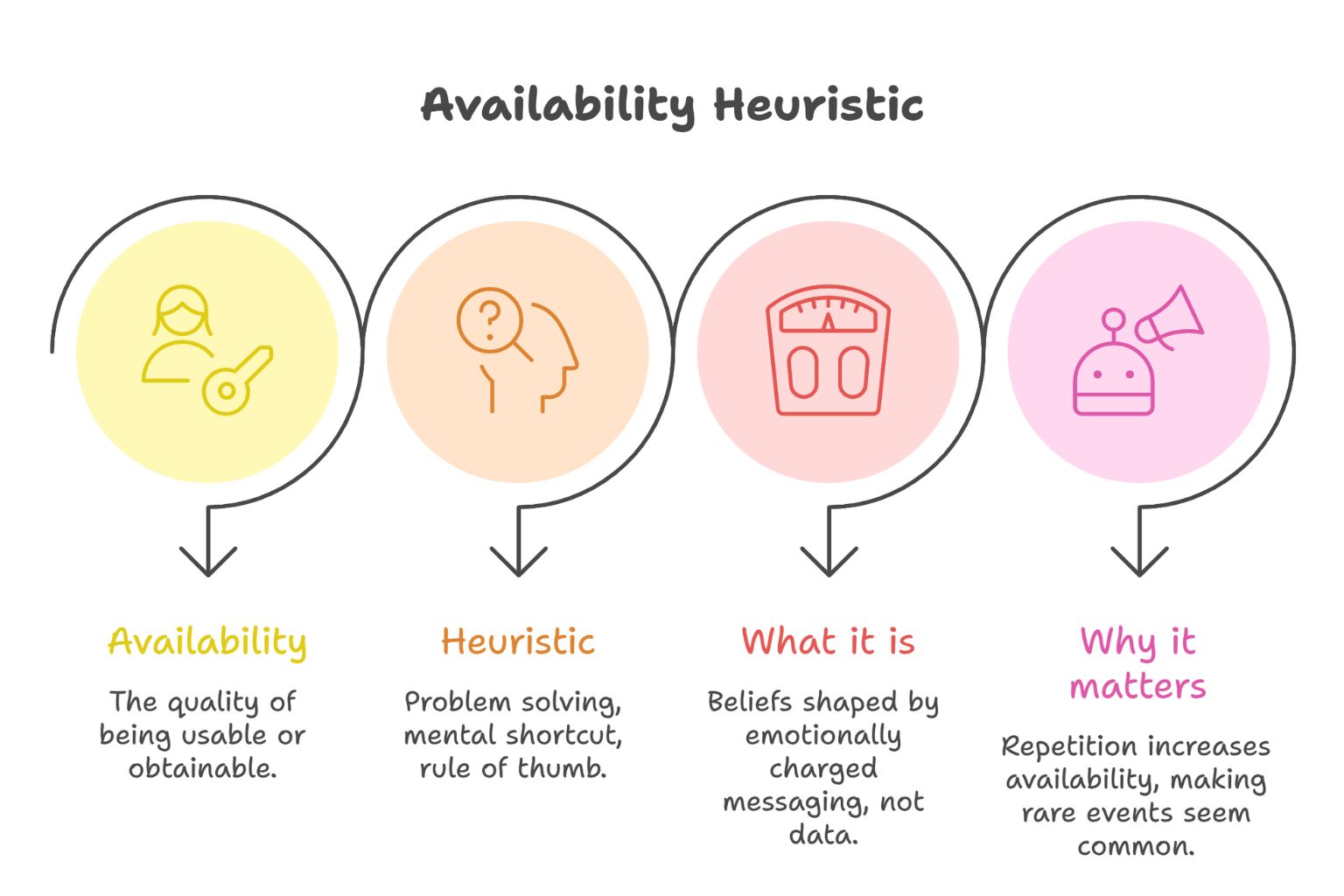
Availability Heuristic
Availability: The quality of being usable or obtainable.
Heuristic: Problem solving, mental shortcut, rule of thumb.
What it is
A 2025 Ipsos poll found that roughly two-thirds of UK people believe crime has increased over the past year, and nearly 90% think that crime and anti-social behaviour are a “big problem” across the country.
This is despite long-term data from the Crime Survey for England and Wales showing that violent crime is between 50% and 70% lower than in the mid-1990s.
Hmm. Interesting.
The statistic was based on long-term trend data (i.e. it was demonstrably true).
The belief was shaped by repeated exposure to emotionally charged messaging, often amplified online.
The gap between what is true and what is believed is a specific kind of cognitive bias called the Availability Heuristic, coined by psychologists Amos Tversky and Daniel Kahneman.
We judge how common or likely something is based on how easily we can think of examples of it.
The mind confuses memorable with frequent.
That shortcut is not stupidity; it is efficiency. Calculating real probabilities all day long would be exhausting.
So your brain uses recall as a proxy for frequency.
Most of the time, that works well enough – until the environment changes…
Why it matters
For most of human history, what was available to your memory came from your immediate surroundings. The people around you, your village, the things you directly experienced.
In today’s world, much of what is available we will never personally interact with.
• headlines
• rolling news
• algorithm-curated feeds
• viral clips
• repeated commentary
• emotionally charged stories
Repetition increases ‘availability’ in our mind. If you see something ten times, it feels common, even if in reality, it is rare.
This is why air travel can feel terrifying after a high-profile crash, even though it is still statistically one of the safest forms of transport.
What about these places?
Dunblane.
Lockerbie.
Hungerford.
Soham.
Aberfan.
Manchester Arena.
Praia da Luz.
Columbine.
Right?
One word and you’re catapulted straight to the fear, horror, sadness, and shock. No context needed.
That is the availability heuristic.
One horribly memorable event can permanently rebrand a place.
“Drinking the Kool-Aid” – blind belief.
“_____-gate” – scandal by suffix.
“Stockholm syndrome” – loyalty under duress.
“Ground Zero” – the epicentre of every disaster.
The brain loves compression; it stores the vivid, emotional, repeat-broadcast moments. It doesn’t store peer-reviewed data by default.
It is why, during COVID, different people felt they were living in entirely different realities.
For some, ICU images and daily death counts dominated their mental field. For others, rule-breaking, economic damage, and overreach filled the frame.
Personally, I ignored the TV as far as possible, built a rudimentary outdoor gym (much to the fury of one of the neighbours) and made the most of the weather.
The dataset each person consumed shaped the atmosphere they believed they were in. Availability becomes the mental environment.
The same applies to politics, which is as hot a topic as I can remember, as I write this.
If your feed repeatedly highlights the most extreme behaviour from one group, that group starts to feel uniformly extreme.
Us and them.
Cops and robbers.
Goodies and baddies.
Your brain treats vivid stories as evidence, and the more emotionally charged they are, the more readily available they become.
Availability does not just shape your opinion, but also your mood.
If your mental input is heavy with conflict, danger, incompetence or outrage, the world feels more hostile than it statistically is. Not because you are irrational, but because your internal sample is skewed.
I think it’s important to remind ourselves that we do not live in “the world” but in reality, just the slice of it our attention repeatedly consumes.
We do, to at least some degree, get to control that part.
Once you see the mechanism, you get to reshape your world.
Real-life examples
After watching a week of true crime documentaries, your neighbourhood can feel less safe.
After reading repeated headlines about the cost-of-living crisis, even minor spending can cause anxious feelings.
After hearing one detailed account of vaccine side effects, the risk can feel widespread.
After seeing repeated clips of a political demonstration, it can feel as though the whole system is crumbling.
However serious, common or likely those things actually are.
Things to try
Without needing to disengage from the world and live on a small island in the Outer Hebrides (although having sampled this, I might still), it helps to sense-check whether you might be in an echo chamber.
When something starts to feel common or inevitable, pause and ask:
- How many independent examples have I actually seen? With my own eyes?
- Is this statistically frequent, or simply vivid?
- Would it feel this widespread if it were not repeated daily?
- What evidence am I not seeing because it is less dramatic?
Very often, the shift is not in the underlying facts, but in the sample size your brain is working from.
When the sample widens beyond headlines and algorithms, perception tends to rebalance.
The world may not have changed as much as your feed has.
Try this today
For one week, notice when you feel certain that something is widespread or worsening.
Trace it back.
- Was it one story?
- Repeated headlines?
- An intense conversation?
- An algorithmic feed?
Simply noticing the source reduces its grip.
Optional challenge
Make a cup of tea and deliberately seek out and read one credible source that presents long-term data on an issue that feels urgent or alarming to you.
Not to dismiss it, but to add proportion.
Balance does not mean complacency – it means accuracy.
A Buddh-ish take
“Mind precedes all things; mind is their chief; they are made by mind.” – Dhammapada
What arises in the mind shapes what feels real.
The Availability Heuristic shows how that process works in glorious or horrific technicolour.
And once you see it, you can choose what you repeatedly expose yourself to.
Back to Mindset Mechanics <
Back to The Vault <