

Desirable Difficulties
Definition
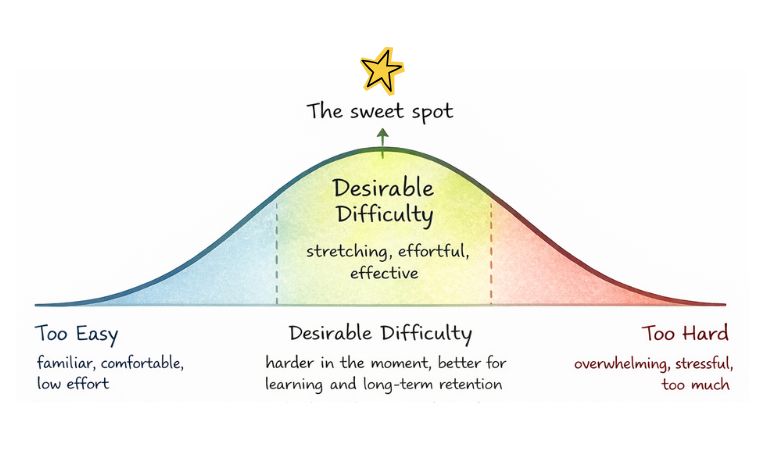
Desirable Difficulties is the idea that some challenges make learning feel harder at the time, but more useful in the long run.
That friction can feel as if it’s getting in the way of your progress. Annoyingly, it may be the part doing the heavy lifting.
What it is – and why it’s useful
Psychologist Robert A. Bjork wrote about Desirable Difficulties in 1994 in his research on learning and memory. He found that some conditions which make learning feel harder at the time can improve long-term memory and help people apply what they have learned in new situations.
The key takeaway is that what feels easy is not always effective.
One way of learning can feel safe and familiar while you are doing it, yet do very little to build real progress. Another can feel more awkward, more demanding, and less immediately satisfying, but help you retain and understand much more.
The tension is between what feels comfortable now and what helps later.
That is the useful bit. Not all discomfort is bad; sometimes the wobble, the effort, the mistake, the repetition, or the awkward beginner stage is exactly what you need to learn something fully.
Some stress, however, is just draining, and some environments are genuinely harmful. Some pressure is too much, too soon, or just misery for its own sake. You are allowed to enjoy yourself.
Spotting the difference has to be an ongoing project.
A worthwhile challenge should feel stretching, not soul-destroying.
Living permanently in beast mode, no pain, no gain, might impress some people, but it is rarely effective in the long run. If it puts you off altogether, makes you miserable, or has you waking in the night in a cold sweat, the means don’t justify the ends.
The other end of the spectrum can be a problem too.
If we treat all discomfort as an alarm bell, awkwardness, challenge, uncertainty, correction, messing up, as if something has gone wrong, we can end up playing things too safe and stagnating.
Sometimes discomfort means you are learning. Sometimes it means you are out of your depth and need support. Useful stretch is not the same as endless anxiety, and resilience is not built by pretending you are fine when you are clearly not.
That feels especially relevant now.
We live in a culture that often tries to make spaces softer, gentler and more inclusive. Much of that is correct, wise and overdue, but it can blur some important edges.
What begins with kind intentions can slide into overprotection. In the long run, that can limit people’s ability to reach their full potential.
Psychological safety is not the same as permanent comfort.
A genuinely helpful environment leaves room for people to feel stretched, challenged, corrected, to mess up, and to be out of their depth at times, but without being shamed, beaten down, or humiliated.
While Bjork’s research focused on learning and memory, the same pattern often appears in other areas of life.
Real-life examples
In the dance classes I teach, a 33-year hobby that has got wildly out of hand, I know that having me at the front makes it easier for the dancers to follow along. They can relax slightly as I demonstrate and cue the next move.
Occasionally, I split them into groups so they can watch each other from the side. This always sparks a brief “Oh hell, don’t leave us” panic, but being on the spot pushes them to retrieve the moves for themselves.
It can feel exposed for a moment, but that effort is exactly what helps them improve.
In the gym, a heavier squat may feel tough at the time, but it is what your muscles need to be stronger at the next workout.
At work, a tough appraisal may sting, but it can lead to sharper thinking and better output.
In conversation, telling the difficult truth rather than the comfortable lie can help the situation move forward with more honesty and long-term clarity.
The awkward, annoying beginner stage is often where the most improvement happens. Desirable difficulty can mean making the choice that makes you take a breath and dig in, not the one that makes you run home for a box set and duvet day.
Try this today
Pick one area where you want to grow and ask a better question.
What kind of difficulty here might actually help me?
- Closing the book and testing yourself?
- Making the awkward phone call instead of another tortured night of thinking about it?
- Trying again with less hand-holding and more self-reliance?
- Letting yourself be a beginner for long enough to become competent?
The aim is not to make life harder for the sake of it, but to recognise that easy isn’t always useful.
Some things to think about
Is there somewhere in your life when you know you sometimes choose comfort over progress?
Do you tend to take the familiar option over what would actually stretch you?
Is there somewhere that the challenge has tipped past desirable into something that is simply too much?
The desirable difficulty sweet spot is between boredom and collapse.
One way is to ask yourself, “Does this feel challenging in a way that makes me curious and motivated to keep going, or am I hating every minute and dreading the next step?”
If you notice you’re learning something new but can still catch your breath and talk about it over a cuppa, you’re probably in the right zone.
- If it’s grimness or exhaustion, it might be time to ease up.
- If it’s all comfort and chill, a bit more stretch could help.
Paying attention to your energy and mood can help you keep testing your limits productively without leaving you frazzled.
Optional challenge
Pick one specific area of work, health, learning, or life this week, and deliberately add one small, useful difficulty.
It could be testing yourself with the book closed and your notes out of sight.
Having the tricky conversation in real life rather than sending a text.
Doing the slightly harder workout, run, or class than you usually would.
See if you can spot the difference between what feels good in the moment and what helps you improve.
Write down three small wins each day, however tiny. Noticing those changes over time can help you see that the effort is having a positive effect, even before the results are obvious.
A Buddh-ish take
“By effort and heedfulness, discipline and self-mastery, let the wise one make for themselves an island that no flood can overwhelm.”
– The Dhammapada
Growth asks more of us than comfort does. But that effort doesn’t have to come all at once, and it doesn’t have to reach the point of collapse.
Just enough, often enough, to make you better.
Back to Mindset Mechanics <
Back to The Vault <