Win at Life

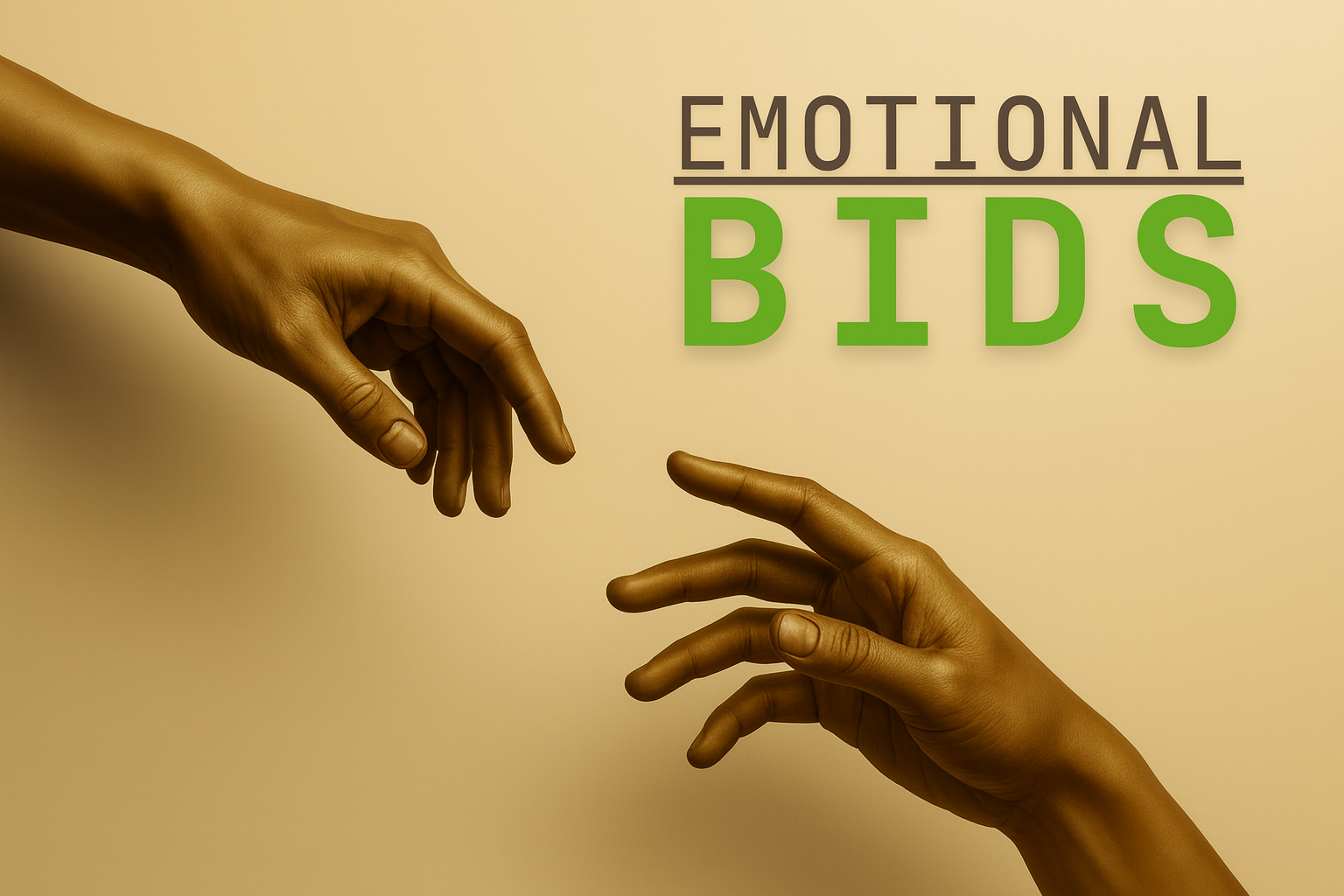
Emotional Bids
Definition
An emotional bid is any attempt someone makes to connect with you, however small. Things like little comments, shared jokes, knowing glances, a sigh, eyebrow raise or even a quick update text.
The Gottman Institute’s research shows that these moments, rather than major events, are what predict whether a relationship will thrive.
The Gottman Institute is a Seattle-based research and training centre founded by psychologists Dr John and Dr Julie Gottman, known for their decades of evidence-based work on what makes relationships succeed or fall apart.
A bid is essentially someone saying, “Are you with me on this?”
How you respond shapes trust, rapport, and long-term ease in the relationship.
What it is and why it matters
Emotional bids are micro-moments of connection. Signals that indicate how someone is feeling and whether they want to be closer, reassured, seen, or acknowledged.
Imagine you say, “Look at that sunset.”
It is not really about the sunset, it’s more about the opportunity of a shared experience of the sunset.
If the other person looks up and joins you, the relationship gets a small deposit. If they miss it, ignore it or half-hear you while scrolling LinkedIn, a little piece of connection evaporates.
This is the power of emotional bids.
They build the mood, tone and emotional safety of any relationship through regular attention and awareness.
Gottman found that in strong relationships, people respond to each other’s bids around 80-90 % of the time. In relationships that later broke down, the rate was closer to 30%.
The issue was more about attentiveness than the strength of the partners’ feelings for each other.
Relationships, they found, most often don’t end because of one dramatic moment.
It tends to be a gradual disconnect because of the small moments that went unnoticed.
It wasn’t about love fading, it was about connection fading.
What bids look like
Some are obvious.
“I’ve had a hellish day.”
“What do you think of this idea?”
“Come and look at this.”
Others are subtle.
A glance.
A small smile.
An in-joke.
A sigh.
A message answered straight away
None of these is asking you to fix a problem. They are asking for a moment of connection or reassurance.
Three types of response
The Gottmans identified three types of connection response:
1. Turning toward
You acknowledge the bid. You look up, respond, ask a question, and show interest.
Even a two-second response counts. It says, “I heard you.” “I shared that.”
2. Turning away
You miss it, ignore it or half-respond. Often unintentional, but repeated often enough, it slowly cools the relationship. Scrolling whilst half listening is a major culprit for this.
3. Turning against
You respond with irritation, criticism or dismissal.
“What now?”
“Can you not see I’m busy?”
This is where the seeds of resentment take root, and closeness begins to fade.
Real-life patterns
Romantic relationships
According to Gottman, at any one time, most couples are not struggling with major conflicts. They tend to struggle more with micro-neglect. A missed bid here, a distracted “hang on a sec” there. It adds up.
The sad part is, most people don’t realise what they’re losing until the warmth has gone.
Friendships
People stay close, not because they agree on everything, but because they keep catching each other’s small signals. When bids repeatedly go unanswered, the friendship becomes functional rather than warm and intimate.
When they’re caught and returned, the friendship strengthens almost without effort.
Family
Children send dozens of bids an hour.
Adults send fewer, but they matter just as much.
The cup of tea offer.
The story from the school day.
The comment about the weather (that is not actually about the weather.)
Leadership and work
Successful leaders, it was found, make far more bids than they realise, and receive far more too.
A colleague says, “Have you got a minute?”
A team member offersan idea in rough-draft form.
Someone shars a small win.
All bids.
Leaders who respond well create psychological safety without needing to state things explicitly.
When these bids are consistently missed, people stop speaking up. Innovation drops, honesty declines, and energy fizzles out.
Most workplace culture issues begin with missed micro-moments, rather than policy. Fix the micro-moments and the culture shifts with them
How awareness helps
Understanding the concept of emotional bids is one of the simplest, most high-impact tools for improving any relationship – professional or personal.
A few small shifts change everything.
- Look up once more often than you think you need to.
- Put the phone away and lean in when someone speaks to you
- A little squeeze of the arm on the way past.
- Sort things out quickly if you miss something.
Let tiny interactions count as connection.
Respond with warmth even when the bid is light.
Recognise when a person is asking for reassurance rather than answers.
People rarely stop bidding because they stop caring. They stop because they no longer expect their bids to be noticed.
Try this today
Catch one emotional bid from someone you care about, or someone you work with, and respond with more attention than usual.
Notice what happens to the quality of the interaction.
It usually shifts right away.
Things to think about
Which types of bids could you overlook because they seem too small to matter?
How do you typically respond when someone tries to connect with you while you’re mid-task?
Optional challenge
For the next 24 hours, catch as many bids as you can – and respond.
The little moments count: a nod, a look, a brief comment, a follow-up question.
Notice how people respond.
People tend to be more receptive and collaborative when they feel seen.
A Buddh-ish take
In Buddhist thinking, attention is a form of generosity. Wherever you focus it, you are giving something of yourself.
Emotional bids are moments that ask for attention, connection, or shared presence.
Signals that ask: “I’m here with you, are you here with me?”
When we notice and respond, we strengthen the thread between us. If we miss them, the thread sometimes thins to the point where it breaks.
Not because anyone meant harm, but because all relationships are built stitch by stitch.
As the Zen teacher Thich Nhat Hanh wrote: “The most precious gift we can offer anyone is our attention.”
Connection rarely hinges on grand gestures. It grows in the pauses, the glances, the “look at this,” the “did you see?” and the “just checking in.”
Little moments, fully noticed, change everything.
Back to Mindset Mechanics <
Back to The Vault <
References
Gottman, J. M., & Gottman, J. S. (2015). The Seven Principles for Making Marriage Work (Updated Edition). Harmony Books.
[Introduces emotional bids and turning toward, turning away, turning against.]
Gottman, J. M., & DeClaire, J. (2001). The Relationship Cure. Harmony Books.
Driver, J., & Gottman, J. M. (2004). Daily marital interactions and the role of positive affect. Journal of Family Communication, 4(1), 1 to 20.