

Definition
Emotional granularity is the ability to describe what you feel with a bit more precision than just “fine”, “stressed”, “annoyed”, or “absolutely fuming”.
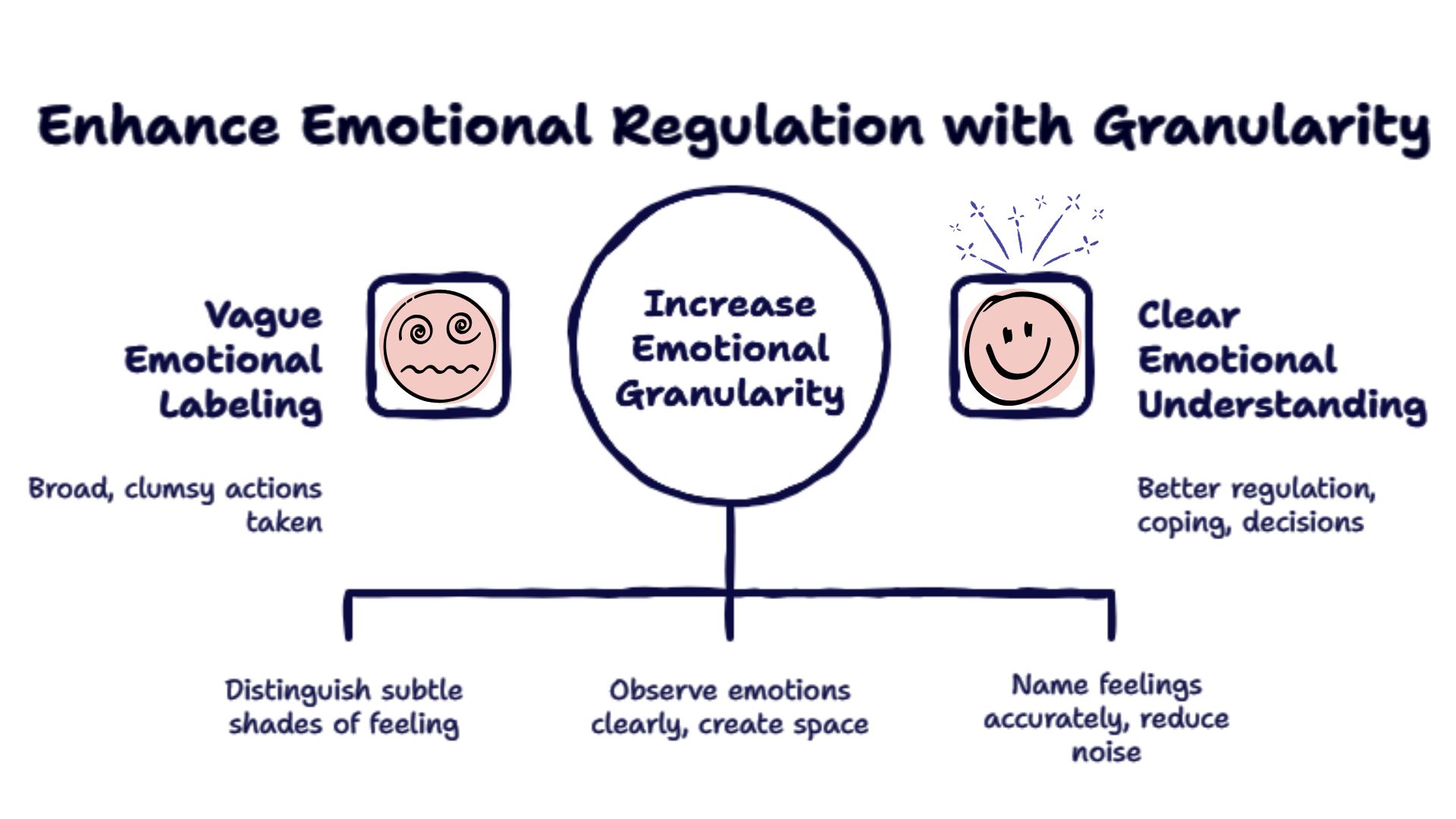
Most of us have a tendency of being vague when interpreting and naming our feelings. We can lump similar feelings together – which makes it hard to take the right actions.
Emotional granularity is being able to distinguish between things like irritation, disappointment, pressure, embarrassment, uncertainty, grief, boredom, or overwhelm.
It’s also worth saying that this isn’t only about the harder feelings. Being able to name the more subtle shades of joy, pride, interest or ease is part of the same skill.
This idea comes from the work of Professor Lisa Feldman Barrett and other researchers in a branch of study called: affective neuroscience.
They found that people with more precise emotional vocabulary are better at regulating emotion (not losing their rag / spiralling into doom) , coping with stress, and making complex decisions.
It is less about becoming poetic and more about becoming accurate. When you can name what is going on, your nervous system has something to work with.
What it is and why it matters
Think of emotional granularity as mental resolution.
High resolution, high information. Low resolution, lots of blur.
If you can only label your internal state as “stressed”, your brain can only take broad, clumsy action.
If you can say “I feel overstretched but not overwhelmed”, “I am irritated rather than angry”, or “I am anxious because something feels uncertain, not because something is wrong”, your responses shift immediately.
This is why the science links higher emotional granularity with lower anxiety, lower depressive symptoms, reduced cortisol spikes, and better executive function.
In a world where many are mentally stretched to capacity, this is an area that we can take logical control of and feel the benefits.
And in leadership, granularity is gold.
A leader who thinks they are “angry” might react aggressively.
A leader who realises the feeling is actually “uncommunicated expectations” or “pressure plus fatigue” has far more room to think, communicate, and strategise.
For relationships, it stops the classic “Are you alright?” “I’m fine” routine, where you both know fine is doing a lot of unhelpful heavy lifting.
Naming the thing accurately makes repair quicker, easier and less likely to spiral into something else entirely.
From a Buddh-ish perspective, this is simply awareness in action.
The moment you observe an emotion clearly, you stop being dragged about by it.
You create a little space between the stimulus, your reaction – and your better next move.
If you are the kind of person who defaults to ‘fixing’ things at the first sign of a problem.
Understanding that sometimes a better label is what will be most helpful.
Real life examples
In day-to-day life, granularity is the difference between “I feel awful” and “I feel socially overloaded after too many interactions” or indeed: “I feel lonely and isolated with too few interactions”.
One leads to resentment or ‘quietly’ coping.
The other points you towards the right kind of action instead of defaulting to your typical numbing habit of choice
In relationships, it can turn an entire conversation. If someone says, “You seem upset”, and you can reply, “I’m not feeling listened to”, you give them something they can actually respond to, rather than “I’m angry”.
Arguments get shorter. Reconciliations are more genuine and long-lasting.
The emotion is no longer a mystery to decode.
It helps with progress too.
If you can name “I feel intimidated, not disinterested” for yourself, you stop avoiding the very thing that would move you forward. It becomes less of a character flaw and more of a solvable feeling.
At work, clearer internal language becomes much more effective external communication.
People trust leaders who can say what they mean without projecting it onto everyone else.
Teams misinterpret less because they’re reacting to your words, not trying to second-guess your tone.
And when life feels overloaded, specificity is weirdly calming.
Overwhelm thrives in vagueness.
A precise label reduces that background mind-spin because your brain stops scrambling around trying to work out what the hell is happening.
A well-chosen name is a tidy box for the feeling to pop itself into.
How awareness helps
You do not need to learn new language.
You need to expand your use of what you know already.
This is a case of the devil being squarely in the detail.
Instead of:
• “Stressed”
Could it more accurately be: “overstimulated”, “pressured”, “time-short”, or “uncertain of the brief”, “understaffed?”
Instead of:
• “Angry”
What about “frustrated”, “defensive”, “hurt”, or “my x boundary has been crossed”?
Instead of:
• “Sad”
Would “lonely”, “flat”, “tired”, “uninspired” or even “nostalgic” be closer to the mark?
Each one points to a different next step or action you could take to resolve things.
This also supports the 90 Second Emotion Rule.
When you can sit with a feeling long enough to name it, the surge passes faster.
Precision reduces fuel.
Try this today
For the next 24 hours, every time you feel something strong, pause for two seconds and try to find a slightly more accurate word.
It could be:
“Irritated” instead of “furious”.
“Unprepared” instead of “anxious”.
“Disconnected” instead of “low”.
You will notice the temperature of your thoughts shift almost instantly, but more importantly – a useful plan of action will become apparent.
Things to think about
Which emotions do you habitually chuck into one big bucket?
Where do you tend to overreact and need to be ‘talked down from the ledge?’
Which relationships would benefit most from clearer emotional language?
How would your leadership/work life change if you could name what is happening rather than express it indirectly?
Optional challenge
Create a short list of ten emotion words you rarely use but think might be more accurate for some of the situations you find yourself in.
Keep them somewhere close.
Each time you feel something physical in your chest, jaw, stomach, or throat, try one of those words on for size.
Tiny distinctions can build better decisions.
A Buddh-ish take
In the Dhammapada, there is a simple idea:
“With understanding, the mind finds peace.”
Emotional granularity is the modern psychological version of that teaching.
By naming our inner experience more clearly, we reduce noise, soften reactivity, and see ourselves with a little more honesty.
Precision is not perfection.
It is presence – and presence is what helps you make better decisions.
Back to Mindset Mechanics <
Back to The Vault <