

What it is
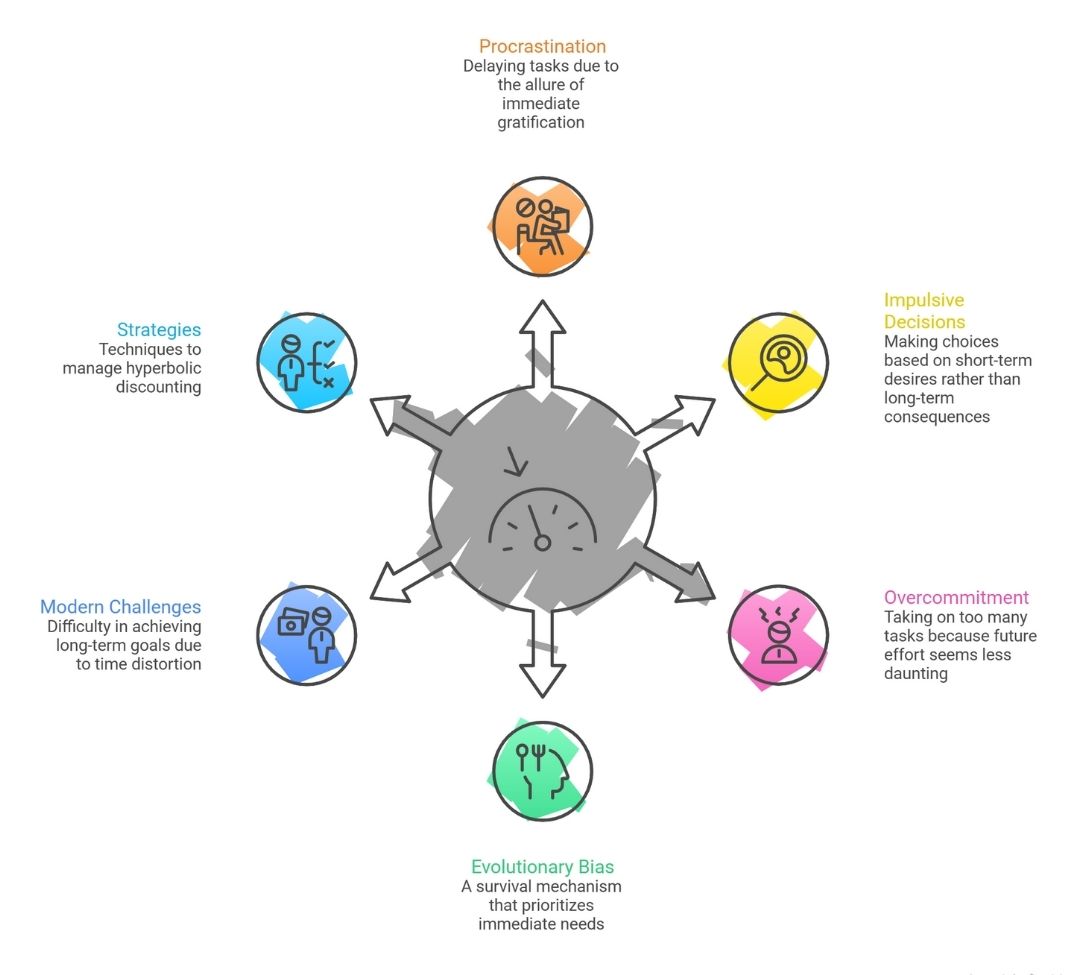
Hyperbolic discounting is the tendency to value immediate rewards more highly than future rewards, even when the future reward is objectively better.
The idea sits within psychology and behavioural economics and is most closely associated with the work of George W. Ainslie, an American psychiatrist, psychologist and behavioural economist.
In the 1970s, Ainslie observed that people don’t discount the future in a smooth, rational way. Instead, we apply a much steeper discount to rewards that are close in time.
Later, economists, including David Laibson, showed how Ainslie’s ideas helped explain behaviours such as procrastination, impulsive decisions, and overcommitment, rather than simply weak willpower.
So in everyday terms, the further away a reward, a consequence, or an outcome is, the less it feels like something you really need to act on now.
What happens now tends to feel really important, colourful and compelling.
Outcomes that are further in the future feel more abstract, are easier to postpone, and are less emotionally pressing.
This is even when we know they are very important.
While this can look completely irrational, it starts to make sense once you realise the system doing the weighing is rigged.
Why it matters
Hyperbolic discounting accounts for much of what people do and then struggle to make sense of afterwards.
These patterns are often labelled as a lack of discipline, motivation, or commitment.
In reality, the intention is usually there.
What’s distorted is the sense of timing.
From an evolutionary perspective, this bias made absolute sense.
When resources such as food, shelter, and clothing were scarce and survival uncertain, prioritising what was immediately available reduced risk.
The difficulty is that modern life depends on delayed outcomes.
Health, savings, skills, trust, education, relationships, and reputation all pay off over time rather than instantly.
A brain built to prioritise the present can undermine long-term aims.
Without understanding this, people tend to push harder or apply more pressure.
That approach is common. It’s exhausting. And it is rarely effective.
Real-life examples
You see hyperbolic discounting everywhere once you know how to spot it.
You accept an invitation to a party weeks in advance because it sounds like a good idea. When the time comes, you really can’t face it.
You intend to go to the gym, save for a holiday, speak up in a meeting, or start the thing you genuinely want to do.
When the moment arrives, the settee, the snack, or the distraction of scrolling wins.
This is also why some people overcommit.
Future effort looks cheap because it feels distant. Present effort feels expensive because it is immediate. Nothing about you has changed, only the proximity of the task.
Hyperbolic discounting is often mistaken for a willpower issue.
(Whole industries are built around that misunderstanding.)
People say things like, “I just need to be more disciplined,” or “I know what I should do, I just don’t do it,” or “I must not want it badly enough.”
This misses the mechanism at play; the issue isn’t desire – it’s timing.
Immediate rewards are overweighted, and future benefits are discounted too heavily in comparison.
Things to try
Once you recognise hyperbolic discounting, the aim isn’t to eliminate it.
You can’t.
The aim is to design your life around it.
That usually means shortening the gap between action and reward, making future consequences more concrete, or reducing the number of decisions that rely on future motivation.
Shortening the gap might mean breaking a big goal into milestones so you are never too far from feedback.
Making future consequences more concrete might involve writing things down, or using accountability mechanisms.
Even a vision board can help because it turns a vague future idea into something your nervous system can actually register. Used properly, it isn’t aspirational fluffy woo.
Reducing reliance on future motivation (which may not arrive) could involve choosing a small number of priorities each day and making sure they are completed.
People are more likely to stick with habits that give immediate feedback, visible progress, and clear milestones.
Not because the habit is easier, but because the reward is closer.
Vague goals struggle for the same reason, they live too far in the future and can’t compete with that delicious immediate gratification.
All ways of making the future feel more tangible.
Try this today
The next time you delay something you genuinely care about, pause and ask:
- What immediate reward am I choosing instead?
- What future benefit am I discounting?
- How could at least part of that benefit be brought closer?
This reframes the question from what is wrong to how time is shaping the decision.
Optional challenge
Pick one thing you tend to postpone.
Think of one way to make the benefit more immediate.
Not bigger.
Just closer.
A milestone, accountability buddy, a visible marker, a clear endpoint, or a small sense of completion is often enough.
This isn’t lowering standards.
You’re correcting for time.
A Buddh-ish take
“The wise do not cling to what they see as pleasant.”
– Dhammapada
Not because pleasure is wrong, but because immediacy is persuasive.
Hyperbolic discounting explains why short-term relief so often outweighs long-term good.
Back to Mindset Mechanics <
Back to The Vault <
References
Ainslie, G. (1975). Specious reward: A behavioral theory of impulsiveness and impulse control. Psychological Bulletin, 82(4), 463–496.
Laibson, D. (1997). Golden eggs and hyperbolic discounting. Quarterly Journal of Economics, 112(2), 443–478.