
Hedonic Adaptation
What it is
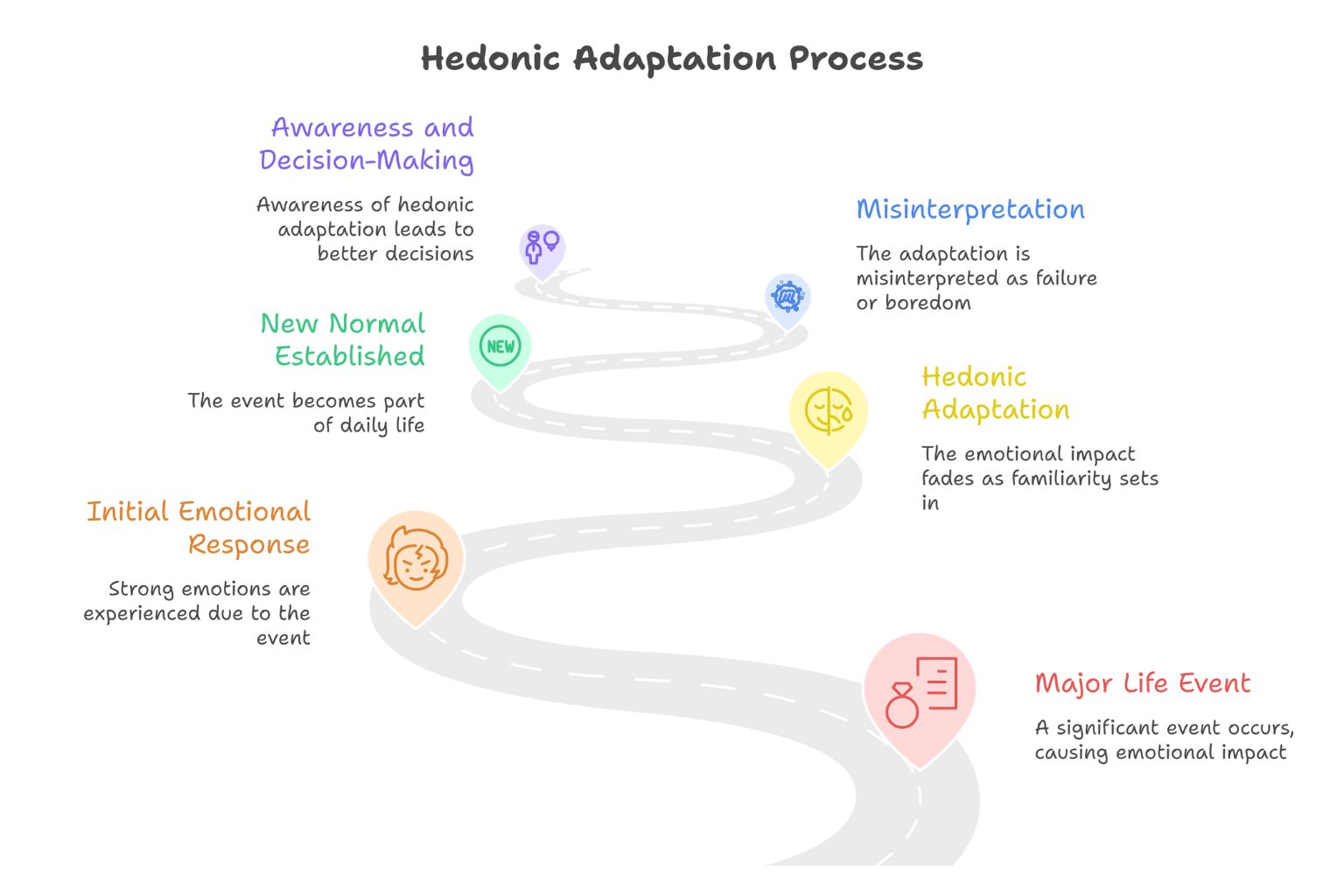
Hedonic adaptation is the tendency for humans to get used to changes surprisingly quickly. Major status-update-worthy life news fades to just background noise. Good or bad, lottery win or serious diagnosis, the emotional impact fades faster than most people expect. What felt exciting or devastating to begin with becomes run-of-the-mill.
The idea comes from both psychology and behavioural economics.
You might have heard this described as a happiness set point, but that only tells part of the story. Researchers often use the image of the hedonic treadmill. Life changes pace or difficulty, but emotionally, you tend to return to your usual speed – your usual level.
The idea is usually credited to psychologists Philip Brickman and Donald Campbell, who studied how people recalibrate their emotions after positive and negative life changes.
Your dream job.
Your shiny new car.
A lifestyle shift.
A big goal finally ticked off.
Eventually, it is just what you have, what you do, and it becomes your new normal.
Many people assume that dissatisfaction means something is wrong. Hedonic adaptation suggests something else: Your nervous system has updated its settings.
Our brains are really good at adjusting to new circumstances. From an evolutionary perspective, this is useful. If novelty stayed ’emotionally dramatic’ forever, we would struggle to focus, to plan or move forward. (We would also be quite a lot to live with.)
The downside is that we can misinterpret this settling as failure, boredom, or lack of gratitude. In reality, it may be none of these things at all, but simply that familiarity settling in.
“I thought this would make me happier.”
“I should feel more excited than I do.”
“Why does this already feel a bit ordinary?”
“Do I still love it?”
“Do I still love them?”
Typically, nothing has gone wrong, Your system has simply recalibrated. You have got used to the ‘new car smell’ of life.
Understanding this matters because without it, people tend to respond by chasing the next high, moving the goalposts, or assuming the problem must be a failing. There must be something wrong with them.
Being aware of the principle of hedonic adaptation can help you make better, more considered decisions.
Real-life examples
A promotion that feels a bit same old, same old after a few weeks.
A new gym routine that stops feeling virtuous and starts feeling like just another thing you have got to tick off.
A long-awaited change that feels like a relief rather than excitement.
But it works in reverse, too.
- A stressful period becomes manageable.
- A terrible loss becomes less painful over time.
- A difficult phase that simply bothers you less.
The pattern is the same.
Emotional intensity fades as familiarity increases.
This is why people often underestimate how adaptable they are to difficulty and overestimate how long satisfaction from improvements will last.
Time does heal, and (sorry), the novelty will probably wear off at least a bit.
Try this today
The next time you notice that something should be great, but is not as shiny as you hoped (#NewYearsEve no further questions, your honour).
Instead of asking what is missing, you could ask:
- What might my system have already adjusted to?
- Would this, at one time, have felt special?
- Can I appreciate this without needing that buzz?
This shifts the question from “Why is this not enough?” to “What has already changed?”
This tends to make things feel clearer and is reassuring.
Some things to think about
Hedonic adaptation is only a problem when we are not aware of it.
People often assume happiness should accumulate. Achievements should permanently lift your mood. The honeymoon phase should last forever.
When reality fails to meet that expectation, frustration, resentment, and dissatisfaction can creep in. And this is where unnecessary striving and drastic changes can begin.
Not because there’s anything wrong with ambition but because the reason for it can be misunderstood. Chasing a feeling that the nervous system is designed not really to hold onto for long – is actually exhausting work.
Hedonic adaptation does not make your goals meaningless. Goals are fantastic for growth, for moving life forward, and for getting the things you want. They are less good at permanently locking emotional states in place.
Satisfaction comes less from reaching new highs and more from being at peace with your choices. Enjoyment becomes easier to find in everyday experience.
Understanding this helps you choose goals for really good reasons and stops you assuming that the next upgrade will fix ‘some kind of feeling’ that perhaps was never caused by its absence.
Optional challenge
Think of something in your life that once felt like a big deal, a big improvement, a big change, but now feels kind of ordinary.
Can you think of three ways that your day-to-day life is genuinely easier, perhaps calmer or richer because of it, even if the excitement has gone?
This can help separate usefulness from novelty.
A Buddh-ish take
“Contentment is the greatest wealth.”
– Dhammapada
Not because life stops changing, but expecting it to keep delivering a home run… is a losing game.
Back to Mindset Mechanics <
Back to The Vault <
References
Ainslie, G. (1975). Specious reward: A behavioral theory of impulsiveness and impulse control. Psychological Bulletin, 82(4), 463–496.
Laibson, D. (1997). Golden eggs and hyperbolic discounting. Quarterly Journal of Economics, 112(2), 443–478.