Win at Life

The Michelangelo Phenomenon
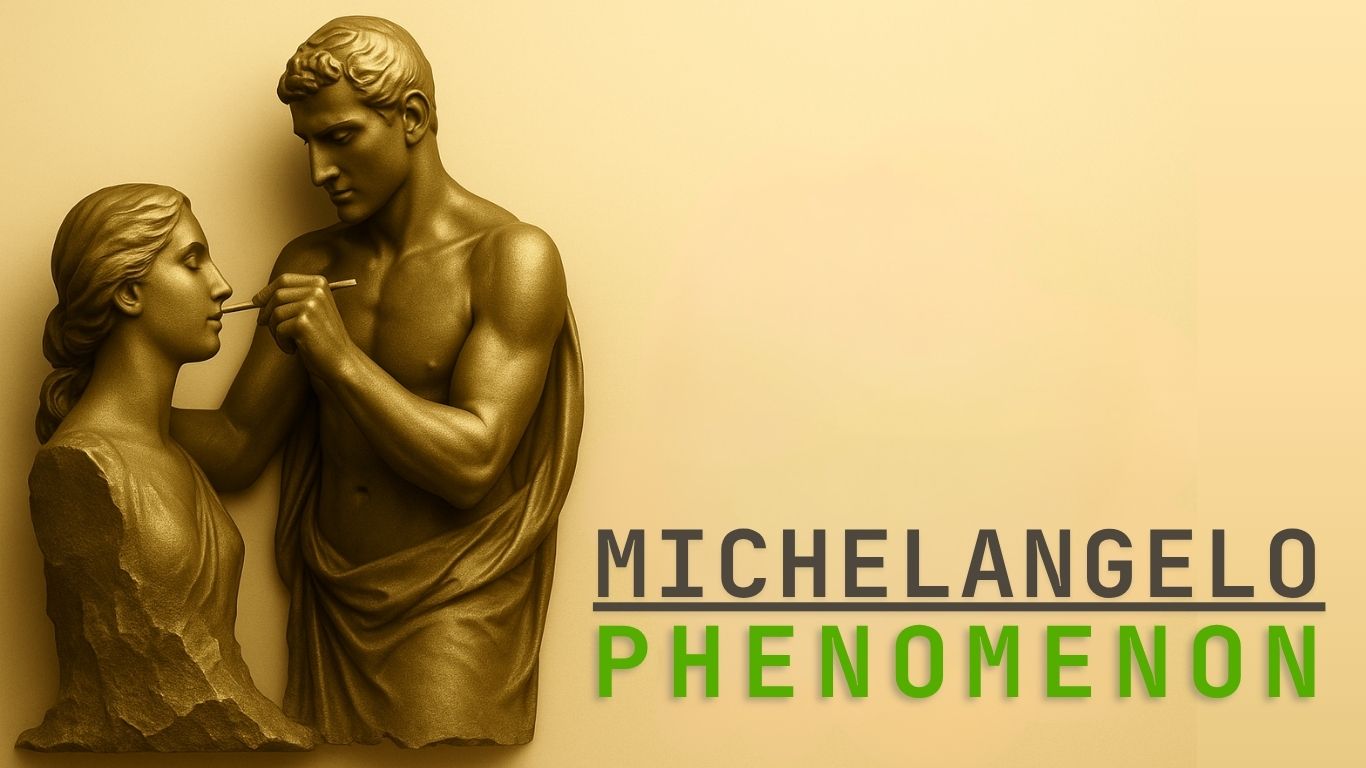
The Michelangelo Phenomenon describes how people in great relationships help each other become their ideal selves. They don’t try to change them, but instead reflect, reinforce, and encourage their best qualities.
The phenomenon is named after the Italian Renaissance painter, sculptor, architect, poet and engineer Michelangelo (1475–1564) – a man who clearly didn’t struggle with finding things to do with his downtime.
Studies have shown that this dynamic is particularly strong in couples who report happy marriages. The research confirmed that long-term happiness isn’t just about being compatible, but just as much about being with someone who regularly reflects back your best bits.
The concept was introduced in the late 1990s by psychologists Caryl Rusbult and Eli Finkel from the United States, along with Edward van Lange from the Netherlands. Their studies found that the people closest to us: partners, friends, family, or colleagues act like sculptors.
Through their reactions, encouragement, and expectations, they shape what we see in ourselves.
What it is and why it matters
The Michelangelo Phenomenon sits beautifully alongside the Pygmalion Effect. Both show the power of belief, but at different scales. The Pygmalion Effect explains how expectations shape your performance. The Michelangelo Phenomenon explains how love – including platonic love – shapes your identity and self-esteem.
This isn’t about finding someone to complete you. It’s about how being known and really seen can bring out the best in you.
The research is very clear. When people feel that those close to them genuinely see and support their dreams and aspirations, they tend to thrive. Confidence increases, wellbeing improves, and motivation goes up. But when someone habitually doubts, criticises, chases up or limits us, we start to play smaller. We live down to their expectations.
The tricky part about this is it’s not just about overt celebration or criticism. It happens almost entirely under the radar, through subtle cues. Tone of voice, body language, attention (or lack of it), curiosity, or indifference.
The way someone excitedly says “Really?” versus a bored “Oh, right.” These cues either fuel or flatten our sense of potential.
We can internalise what the people around us mirror back without even noticing how it plays out.
Romantic relationships
Healthy relationships act like mutual growth projects.
Each other’s number one cheerleader, PR agent, advocate, and support crew. You become more yourself, not less. The best partners hold a vision of who the other is capable of being. They treat that version as a ‘done deal’, even if the other person is doubting themselves or not quite where they want to be yet.
Unhelpful sculpting is when someone tries to carve you into a version that suits them. It looks like, “You could be so successful if you just…” or “Why don’t you try being more like…”, or “If you just tried a bit harder, or weren’t so… or stopped doing… you could really make something of yourself.”
On the face of it, that sort of looks like encouragement, but in practice feels more like control. Healthy encouragement is a mirror, not a mould.
Friendship
Friendships are often where this idea shines brightest, without the baggage. The right friend reminds you of your better angles: the moments when you’re funny, competent, calm, generous, gorgeous. You feel lighter, more at ease. They reflect you in a way that lifts you up.
Other friendships, though, can keep you stuck in outdated roles; the wild one, the sensible one, the organiser, the flake. It’s not malicious. Often it’s just habit, but it can keep you from evolving. There’s no need to cut those people off. Maybe just update them, or recognise which version of you they’re sculpting and act accordingly.
Family
Families are where our earliest chiselling begins. Parents, teachers and relatives carve the first outlines of how we see ourselves. “She’s the clever one.” “The shy one.” “The cheeky one.” Decades later, those labels can still quietly whisper in our ear and steer us like an automatic car.
The Michelangelo Phenomenon gives us permission to re-sculpt those early models. We get to decide which inherited identities still fit. There’s no need to rebel, but you can update.
And if you’re the parent now, this awareness changes everything. Praising effort, curiosity and kindness keeps all options open. It avoids locking children into traits like “the maths one” or “the sporty one”, “the good girl”, “the little terror”. You’re shaping the foundation they’ll build on later.
Work and leadership
In leadership, this principle is gold dust. The best managers and mentors act like expert sculptors. They see potential before it’s been proven and behave as if it already exists, and that belief becomes contagious.
People rise when they’re reflected as capable. The opposite is also true. If you constantly correct and criticise, you’re chiselling doubt. You get to gently carve confidence or anxiety – and that’s a powerful thing to know.
Real-life examples
Imagine you mention to your partner that you miss painting. A couple of days later, an Amazon parcel arrives with a sketchbook and watercolour paints inside.
There’s no “Why don’t you then?”, “Stop moaning about it”, or “You haven’t got time with everything on your plate, really.” Just no-pressure encouragement.
Or you tell a friend you’re thinking of leaving your job, and they tilt their head and say, “You have sounded fed up for ages. Have you thought about what you’d do instead?” Rather than pushing or prying, they’re just inviting the better version of you to step forward.
Your line manager hands you a project that’s slightly beyond your current role. They trust you’ll handle it and you totally smash it, because their belief in you boosted your confidence.
Maybe after years of dispensing life advice, a parent finally says, “Whatever you choose will be the right thing. You know what you’re doing.” Suddenly, you know exactly what to do next.
That’s the Michelangelo Phenomenon in motion. The act of being seen in the direction that you’re trying to grow.
Why it’s useful
It isn’t just a theory; it’s a strategy. It informs how you choose your company, manage your teams, and nurture your relationships.
You can ask two powerful questions:
1. Who am I sculpting?
Through my reactions, my attention, my tone. Am I helping this person expand, or contract?
2. Who is sculpting me?
Whose belief or doubt am I breathing in every day, and does it fit with who I want to be?
When you see it like this, every interaction becomes a kind of micro-sculpture. You start noticing which relationships leave you energised and which ones sandpaper your soul, ever so slightly, each time.
Try this today
Pick one person you care about: a partner, friend, colleague, or child. Picture the version of them they’re aiming for. Not the perfect one, just the version you know they’d be proud to become.
Then interact with that person – the one on their way there. Ask about their ideas, reflect back their strengths, treat them as if that version already exists.
You’ll notice the temperature of the relationship change. It gets lighter, closer, and more positively charged.
And when you catch yourself feeling smaller in someone else’s presence, don’t panic. That’s feedback, not failure. It’s a cue to spend more time with people who encourage you to expand, not contract.
Some things to think about
- Who helps you become your best self? Not necessarily your loudest or most productive self, but the one you actually like being?
- Are there people who still see an outdated version of you?
- Which of your relationships challenge you to grow in healthy ways. Which ones chip away at your confidence?
- How do your words and actions sculpt the people around you?
Optional challenge
Pick one relationship and do a Michelangelo Phenomenon audit.
How do you see this person’s potential?
How do you reflect it back to them, if at all?
Where might you be pushing too hard, or carving them into your image instead of their own?
Then flip it.
Who is currently shaping you, and are they working from a kind or a critical vision?
A Buddh-ish take
“No one saves us but ourselves, yet none of us do it alone.”
In Buddhism, the idea of dependent origination teaches that everything arises in connection. Nothing exists in isolation.
The Michelangelo Phenomenon is a psychological echo of that truth. We become who we are through the mirrors of other people’s attention.
Every conversation, every response, is just a little tap of the chisel. Use it kindly. Not to ‘perfect’ anyone, but to reveal what’s already on the inside.
Back to Mindset Mechanics <
Back to The Vault <
References
References
Finkel, E. J., & Rusbult, C. E. (2008). The Michelangelo phenomenon: How close partners influence one another’s ideal selves. In J. V. Wood, A. Tesser, & J. G. Holmes (Eds.), The Self and Social Relationships (pp. 317–342). Psychology Press.
Rusbult, C. E., Finkel, E. J., & Kumashiro, M. (2009). The Michelangelo phenomenon. Current Directions in Psychological Science, 18(6), 305–309.
Drigotas, S. M., Rusbult, C. E., Wieselquist, J., & Whitton, S. W. (1999). Close partner as sculptor of the ideal self: Behavioral affirmation and the Michelangelo phenomenon. Journal of Personality and Social Psychology, 77(2), 293–323.