Win at Life

Moral Licensing
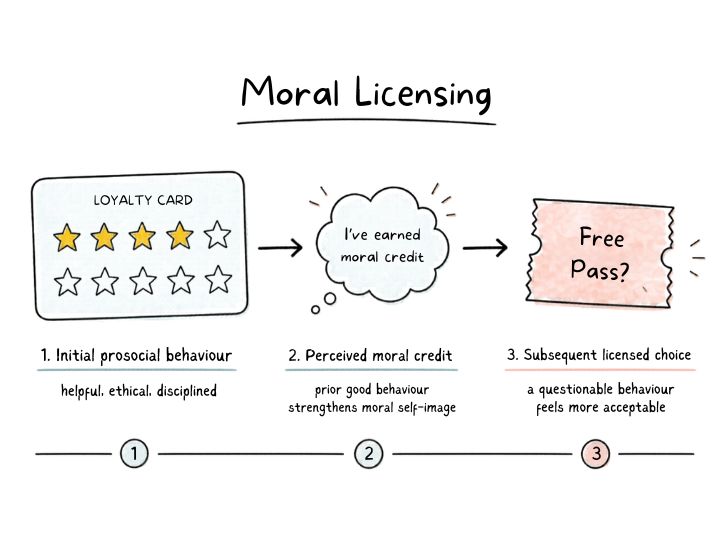
Moral licensing, or moral self-licensing, is when people allow themselves to make more questionable choices after doing something that makes them feel decent, fair, or generous.
Like a moral loyalty card, doing good deeds can feel as if we’ve earned points to spend on slightly dodgier choices.
“I’ve spent £800 at this supermarket this month; I’m not scanning the carrier bag.”
“The amount of charity work I do, I should be allowed to rob at least one bank.”
“I’ve been married thirty-five years – I’d have done less time for murder!” (Not quite moral licensing, but a regular quip from my aqua aerobics group.)
Clearly tongue-in-cheek fun rather than actually sinister – the joke lands because we recognise the logic.
Most of us know the internal bargain: I have been ‘good’, so this compromise feels justified.
I have helped out, so I can put my foot down.
I have worked hard or been patient, so this one thing doesn’t really count.
I’ve eaten ‘clean’ all week, so I’ve earned this pizza.
The issue isn’t that we want to reward or treat ourselves; it’s that we risk using a past good deed as an excuse to justify choices that don’t match our values, distorting our judgment in the process.
What it is – and why it’s useful
In 2001, social psychologists Benoît Monin and Dale Miller studied “moral credentials”. The idea is that once people feel they have established themselves as fair-minded, they may become a little more relaxed about saying or doing something questionable later.
Later work by Anna Merritt, Daniel Effron and Benoît Monin called this moral self-licensing: the idea that being good can make us feel freer to be bad.
TL:DR Humanity isn’t doomed.
Quick caveat: a 2015 review of 91 studies found a small-to-moderate moral licensing effect, so this is useful as a pattern to notice, not a guaranteed rule of behaviour.
The point is not to tip into cynicism or become suspicious of every good deed, including your own.
You might feel guilty about resting or enjoying yourself, thinking, “I’ve been sitting down for too long, I should really be getting on with things.”
Or you might wonder, “What’s in it for them, what are they up to?” when someone is just being generous.
The main value of understanding moral licensing is that it shows how our self-image can tempt us to excuse poor choices. It helps us spot the moment our “good person” identity starts covering for our less-than-finest hours.
We literally let ourselves off for good behaviour.
Integrity means more than seeing ourselves as decent or fair. The real measure is whether our choices consistently match our values.
Real-life examples
You spend Saturday helping at the school fayre, moving tables, putting up bunting, guiding cars in the car park, and painting snotty five-year-old faces. Half the helpers didn’t materialise, and you’re still smiling politely.
Later, when someone asks the same question you’ve had twenty times, you snap an answer at them. After all you’ve done, surely they can handle a bit of straight talking.
(The loos are clearly signposted. I put the signs up personally, Susan.)
That is moral licensing. Your brain has used your prior efforts and hard work as permission to relax your standards of kindness later.
It’s a big issue in relationships.
Years of loyalty, patience, and support from one person can build up and, rightly or wrongly, start to feel unappreciated. They might withdraw their efforts, become distant, give the silent treatment, or seek comfort elsewhere rather than dealing with the issue directly. They may genuinely deserve more rest, appreciation, help, space, or an honest conversation.
But when “after everything I do for you” or “I shouldn’t have to explain it” becomes a way to avoid taking responsibility for current behaviour, that’s moral licensing in action. Or more accurately, inaction.
In the workplace, positive self-perception can lead to moral licensing. A manager who sees themselves as “the supportive one” might dismiss complaints about favouritism, believing their overall goodness outweighs any criticism.
Treat days are a classic example. A planned indulgence is one thing; saving up all your healthy tokens for a weekend blowout is where the maths gets creative.
Charity work can work the same way: people give time, money, or energy and start to see themselves as one of life’s good guys, which can lead them to overlook smaller lapses.
I know an outrageous gossip-monger who delights in telling you how much they volunteer in the second-hand shop, along with everyone else’s private business. And someone else who raises tens of thousands of pounds a year for worthy causes, who is as cutthroat and ruthless in private as anyone I have met.
None of that diminishes their hard work – it’s still important and admirable – but genuine contribution can sometimes be used to paper over some of the grubbier parts of us.
Why it matters
Moral licensing is tricky because it lets us deceive ourselves while still feeling morally intact.
“I deserve this” may be completely true.
You may genuinely need support, a break, a boundary, a change of pace, or a fair hearing about the unfairness of you always being the one who has to hold things together.
But sometimes it isn’t really about equity or need. It is more of a free pass to let you dodge the more useful question: Is this choice still in line with the person I want to be?
Genuine rewards can be enjoyed guilt-free. You worked hard, so take the evening off or say no to another demand. That’s maturity and experience, not moral licensing.
Moral licensing is less about justice or restoration and more about exemption. It suggests that because you have been good over there, no-one needs to look too closely over here.
When we let our self-image as a good person distort our actions, our decision-making suffers because we no longer view our choices objectively.
If you see yourself as generous, you may miss when you are being resentful. If you are the hardworking type, impatience can feel justified. Loyalty can mask control, bitterness, or martyrdom.
An office Christmas party snog is barely cheating if you arranged the whole event, right?
Does what goes on tour actually go on tour, when you’re blowing off steam after a successful season?
The difficult part is that moral licensing challenges our favourite self, not our worst self. It asks us to look at the version we are proud of and notice where that pride may be acting as wingperson.
It’s super annoying.
Moral licensing and Moral Drift
Moral licensing is closely related to Moral Drift, but they are not the same thing.
Moral Drift is gradual. It is the slow movement away from your values through tiny compromises, repeated often enough that they begin to feel normal. One day, you simply realise that something you once would have thought of as wrong has slipped under your radar.
Moral licensing is more transactional. It’s the internal maths that says: because I’ve done this good thing, I’ve built up tokens for this bad thing.
With moral drift, patterns appear over time. With licensing, it’s a moment-to-moment transaction. It’s like trying to pay with fake money.
Try this today
Notice the next time you think, “I deserve this.” You absolutely might. But once you have noticed the phrase, separate the possibilities.
- Is this a genuine need?
- Is it a reasonable reward?
- Or is it a licence to do something you already know you really shouldn’t?
A genuine need restores you and doesn’t need a defence. A licence often comes with a convenient narrative, because a part of you knows the choice is, at least, a bit suspect.
What we do in the shadows, as they say.
Some things to think about
- Where do you tend to keep score?
- Are there parts of your identity that can make you harder to challenge?
- When someone gives you feedback, do you listen to the specific behaviour, or tend to defend your entire character?
- Where might “I deserve this” be true, and where might it be taking some liberties?
Optional challenge
For the next seven days, notice any moment when you mentally cash in or bargain using your earlier goodness.
It might sound like, “I’ve worked hard, just this once won’t hurt,” “No chance, I’m always the one who helps,” “I’ve had a difficult week, I deserve one thing for myself,” “at least I’m not as bad as them.”
Write it down, then ask whether it is a fair point or just an attempt to avoid a more decent choice.
A Buddh-ish take
“As a solid rock is not shaken by the wind, so the wise are not moved by blame or praise.” – Dhammapada, verse 81.
To me, this suggests that a wise person’s sense of self comes from within – not from terms, conditions, or quid pro quo.
Instead of chasing approval or using good deeds as ‘cover’, integrity comes from honest self-reflection and staying true to your values.
Back to Mindset Mechanics <
Back to The Vault <