Win at Life

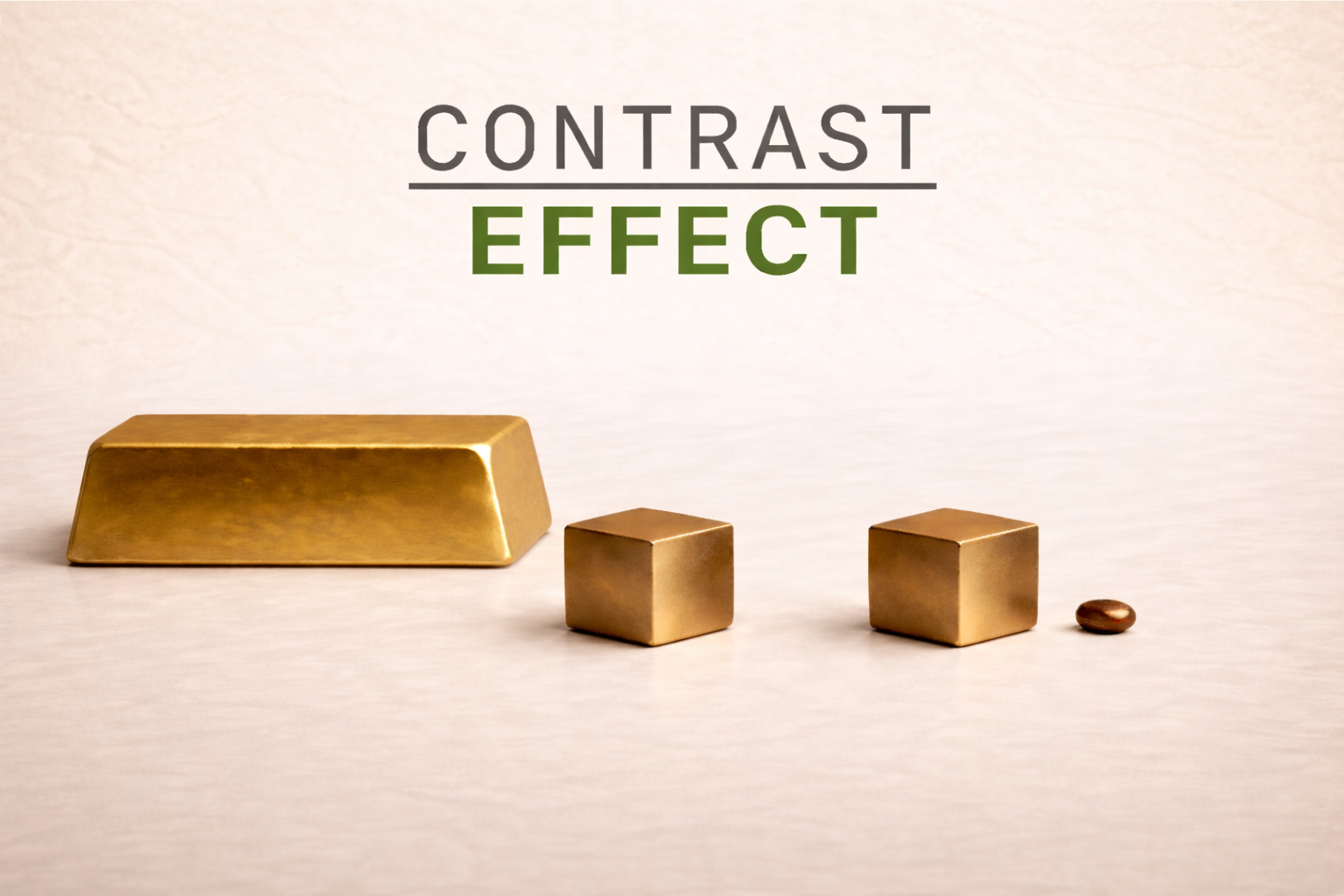
The Contrast Effect
Why your judgement shifts depending on what it’s standing next to
What it is – and why it’s useful
The Contrast Effect describes how our minds judge something not just on its own value, but in relation to whatever else is nearby, recent, or mentally prominent.
When we’re presented with two things close together, or we experience them in sequence, the difference between them feels amplified.
Psychologists began formally studying contrast in the mid-20th century while examining how people form judgements and establish baselines. Researchers such as Muzafer Sherif showed that once a reference point is set in our minds, subsequent evaluations are pulled towards it or pushed away from it.
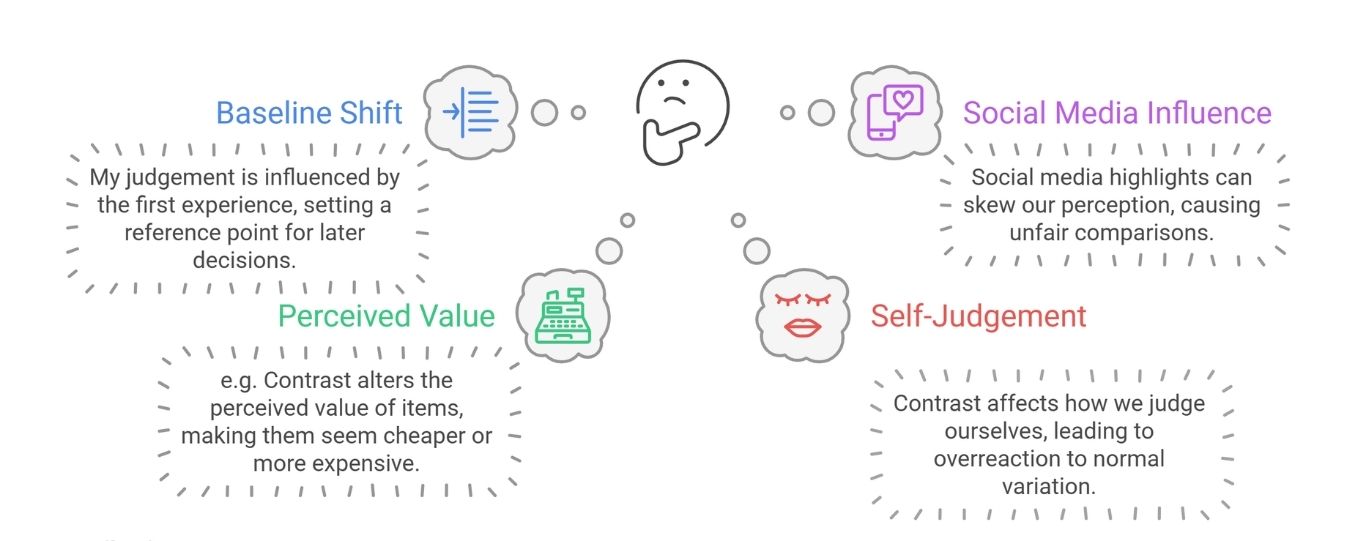
The first number you hear, the first performance you see, the first spaghetti bolognese you experience, those become the comparison point.
It doesn’t mean that you are bad at making decisions. It means your brain works comparatively. Absolute judgement of something takes effort and calculation. Relative judgement is quicker. We tend to ask ourselves whether it is better than that, or worse than that.
The problem isn’t comparison. It’s forgetting that the comparison is happening.
Real-life examples
Imagine you’ve been house hunting for weeks. You’ve seen so many now it’s getting really tough to choose.
Then you see a genuinely dreadful house with damp patches, terrible furniture, a weird layout, and a very suspicious smell. It is obviously a no.
The next perfectly presentable, typical house feels completely charming and you put an offer in straight away.
The second house wasn’t necessarily that much better than the ones before. Your baseline just moved.
The same thing happens with pricing.
You see a jacket for £1,800. It must be in a very posh shop and you would never pay that for a jacket.
Next to it there’s a very nice one – a steal at just £650.
This one feels almost restrained, although quite possibly outrageously overpriced.
Retailers understand this.
Three-tier pricing structures are not an accident. That premium option often exists just to make the middle one feel sensible.
Negotiation works in the same way. Starting off outrageously high shifts what feels acceptable. If they don’t just walk out, the eventual agreement lands closer to your opening price than it otherwise would have, simply because that first number altered the frame of reference.
Contrast also shapes how harsh or how forgiving you are with ourselves.
A salesperson could have had an exceptional, record-breaking month and feel absolutely on fire. Then follows a perfectly respectable, but typical month, which leaves them feeling like a failure.
Or after a stretch of peak fitness, a very normal training phase can feel like regression.
Nothing has necessarily got worse.
The comparison has just changed.
Why it matters
Contrast alters the perceived value of something without altering the thing itself.
It influences what feels expensive, impressive, who feels gorgeous, what feels disappointing, what feels generous, and what feels slow or flat.
It also influences your mood.
If you’ve just experienced the intensity of the honeymoon period in a relationship, the calm that follows can, for some people, feel dull by comparison.
If you’ve just experienced a chaotic nightmare of a time, stability can feel extraordinary.
The context shifts the scale.
In modern life, the comparison point may not even be something you’ve directly experienced. It might be what your social media feed showed you, what someone else announced, or the extreme example that grabbed your attention.
We judge ourselves by other people’s highlight reels, and our perception shifts accordingly.
If you’re unaware of that shift, you can overreact to normal variation. You can pay over the odds because something seems cheap by comparison. You can undervalue the progress you’ve made because it follows an early peak. You can judge yourself unfairly because you’re measuring against an unsustainable high.
Contrast doesn’t remove your ability to reason, but it does skew and tilt it… at least a bit.
Try this today
When something feels unusually good or unusually disappointing, take a second and ask yourself whether you are comparing it to something else. If so, what? Is that comparison fair?
If you had nothing to compare it to – and it stood just on its own merits, how would you see it?
This isn’t about dismissing your reaction but adding proportion and perspective to it.
Some things to think about
- Are you letting a ‘high’ distort your view of progress?
- Are you letting a recent low point make normal effort feel impressive?
- Are you reacting to the thing itself, or to the contrast around it?
- Is your current judgement of someone, something, or yourself based on reality, or on the last extreme you encountered?
Optional challenge
For one week, simply notice comparisons as they arise.
Notice when something feels like a bargain because of what came before and ask yourself whether you are buying it for the thing itself or just for the Clubcard points.
Notice when something feels like a failure because it follows something highlight-reel worthy.
Notice if your mood swings because the backdrop changed.
This is not about trying to change or fix anything. It is about seeing the measuring process happening. That, on its own, can reduce its grip and help you look at things in a more balanced way.
A Buddh-ish take
This is the very first sentence of the Dhammapada:
“All that we are is the result of what we have thought.”
The mind measures automatically. Things are better than, worse than, more than, or less than something else.
Seeing the measuring doesn’t stop it from happening, but it does help you step back, stop blaming the world every time the scale swings, and recalibrate to a more balanced perspective.