
Cognitive Dissonance
Cognitive Dissonance
What it is – and why it’s useful
I’d stick my neck out and say that most of us think that how we act matches up with what we believe.
We would say we live according to our values, and we make choices that reflect the kind of person we see ourselves as. Of course we do.
Until something shows us that we don’t.
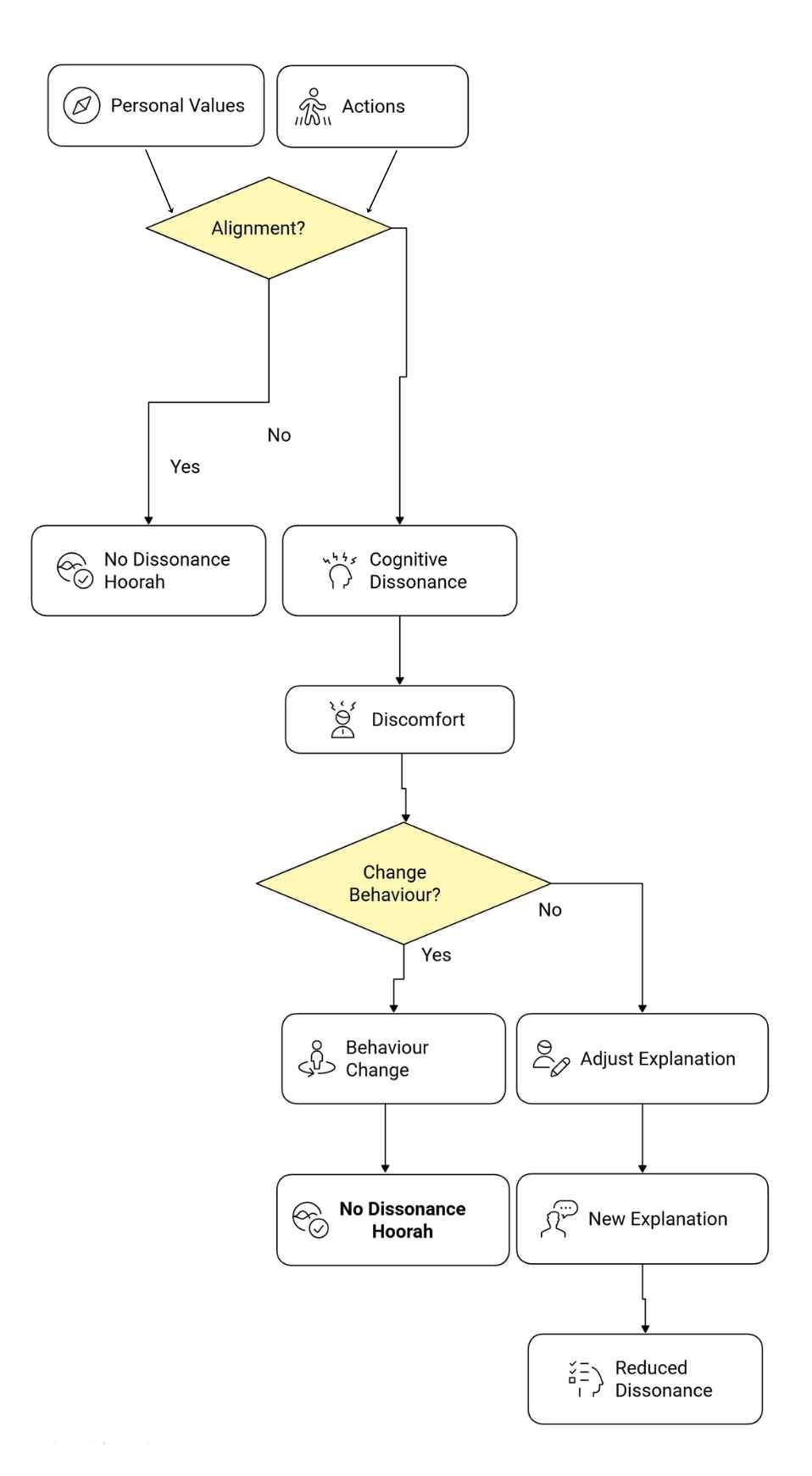
When the alignment between personal values and actions breaks down, our brains experience a particular kind of psychological tension called cognitive dissonance.
Cliff notes: We tend not to take the news well.
The concept was introduced by social psychologist Leon Festinger in the 1950s. His research suggested that when our behaviour contradicts our beliefs, the resulting discomfort pushes us to resolve the conflict.
In theory, the most straightforward, direct solution would be to change the behaviour.
In practice, our minds tend to take the scenic, more comfortable route. Instead of adjusting what we do, we adjust the explanation.
A person who values health but continues smoking might comfort themselves with the story that their aunt Vera lived to 94 and smoked 40 a day.
Someone who prides themselves on honesty might describe a lie as “protecting someone’s feelings – just being kind.”
A manager who prides themselves on being fair might decide an employee is oversensitive rather than considering that they may actually have been too harsh.
The narrative in their mind tidies things up just enough to make the behaviour feel consistent with the identity.
Cognitive dissonance is hypocrisy’s younger, more well-meaning sibling. It is the mind trying to maintain a coherent sense of self.
Most people want to feel they are reasonable, just and morally consistent. When reality disrupts that picture, something has to give.
In self-aware, reflective people, it can be the behaviour. Very often, though, it’s an entire biography rewrite.
Real-life examples
- Someone spends a wodge of money on a product that turns out to be disappointing.
Admitting the mistake would feel uncomfortable, so the person begins to emphasise its strengths and overlooks the obvious flaws.
- The same could be said of some high-end brands.
When the end user discovers that the same factory supplies the budget outlet and only the tags are changed, they can still swear they can feel, smell or taste the quality. - An athlete who values discipline skips several training sessions.
Soon, the training programme itself starts to look poorly designed or unnecessary, and they employ a new coach (see also: carb-loading/active recovery).
- A person who sees themselves as environmentally conscious continues flying frequently.
They double down on buying reusable products and recycling as evidence that they are doing their part.
You can see the same pattern everywhere once you start looking.
Someone buys an expensive bottle of wine and insists it tastes fantastic, even if it does not.
A person who queued for two hours for a concert convinces themselves it was the best night ever.
A long meeting that produced little progress is later described as “productive.”
The overnight queue at the futuristic gadget shop for the latest iThing might have been uncomfortable, and you could have got it easily the following week – but it was definitely worth the wait.
In each case, the brain sticks all the contradictions between expectation, identity and reality together with mental Blu-Tac.
The explanation itself bends and flexes so the self-image can stay intact.
Why it matters
Cognitive dissonance explains why people often defend decisions long after evidence suggests they were mistaken.
Why do they keep supporting their football team through a second relegation?
Admitting the error would require more than changing direction. It would also mean accepting that the earlier choice conflicted with their identity.
The level of discomfort people feel when owning up to their past bad decisions is surprisingly high. People generally just keep going and defend the original decision.
Businesses often continue investing in failing projects because acknowledging the mistake would mean admitting that someone made a massive strategic boo-boo at some point.
Political supporters reinterpret events to protect their allegiance to a party or leader. Even faced with hard evidence.
People expend enormous energy to justify ‘bad’ habits because confronting them would challenge their sense of who they are.
The stronger the identity attached to a belief, the stronger the dissonance when evidence contradicts it.
This is one reason arguments rarely change minds.
Presenting new information can actually increase resistance.
You feel you’re presenting them with great information, but they interpret it not as evidence, but as a threat to identity. Their minds head in search of reasons to dismiss or reinterpret it.
Cognitive dissonance also explains why people sometimes become more committed to a belief after making a public statement about it. Once you’ve gone public, abandoning your plans risks embarrassment or loss of face. The pressure to maintain consistency grows stronger.
On the positive side, cognitive dissonance can also be a superpower.
If someone publicly commits to a goal, the desire to remain consistent with that commitment can increase the likelihood they will do what they said they would.
An announcement that you will ‘exercise daily’, ‘save money’, and ‘complete your memoir’ this year introduces a small amount of reputational pressure.
Motivation by reputation.
Cognitive dissonance means your mind then nudges behaviour to match your self-declared monastic/entrepreneurial/creative identity.
So that’s the good news – the same mechanism that protects your ego can also reinforce positive habits.
n.b. My tip on that one is: if you are going for the public-service-announcement approach, perhaps stick to one thing at a time. The more dramatic the change, the bigger the dissonance if you don’t achieve it all.
Try this today
Think of a belief you hold about yourself.
Perhaps something like:
- “I’m organised.”
- “I’m fair.”
- “I take care of my health.”
- “I’m good with money.”
Now consider whether your recent behaviour consistently supports that identity. If there is a mismatch, notice the first explanation your mind offers.
That explanation is often cognitive dissonance doing its work.
Seeing the mechanism clearly creates a choice: you can adjust the story – or you can adjust the behaviour.
Some things to think about
- Where in your life might your behaviour and values be slightly out of alignment?
- Are you explaining the gap away rather than addressing it?
- When you defend a decision strongly, are you protecting the idea itself or the identity attached to it?
- How comfortable are you with revising your own story?
A bit squirmy? If so, it usually means you are on the right track
Optional challenge
Choose one small area where your behaviour and values are slightly ‘on the wonk’.
Instead of explaining it away, make one small adjustment that closes the gap. It does not need to be a huge thing; the goal is alignment, rather than perfection.
Small corrections often feel surprisingly relieving once the tension disappears.
A Buddh-ish take
The Dhammapada includes the line:
“Though one may speak many sacred words, if one does not act upon them, that heedless person is like a cowherd counting another’s cattle.”
Knowing what is right and living in accordance with it are not the same thing. Cognitive dissonance lives in the space between belief and behaviour.
When the two align, your mind feels more peaceful. When they don’t, your story can begin to bend. Noticing that bending is often the first step toward straightening things out again.
Back to Mindset Mechanics <
Back to The Vault <