
Impression Management
Impression management is the art of steering how others see us. Most of us do it constantly, whether we realise it or not.
That might sound dastardly and calculating, but it is rarely as sinister as it seems. It can be as simple as speaking more professionally in a meeting than at a nightclub, or trying not to look flustered when you’re actually bricking it.
What it is – and why it’s useful
The idea was popularised by sociologist Erving Goffman, who used the metaphor of performance to describe social life – arguing that we all present ourselves differently depending on who’s watching and what’s at stake.
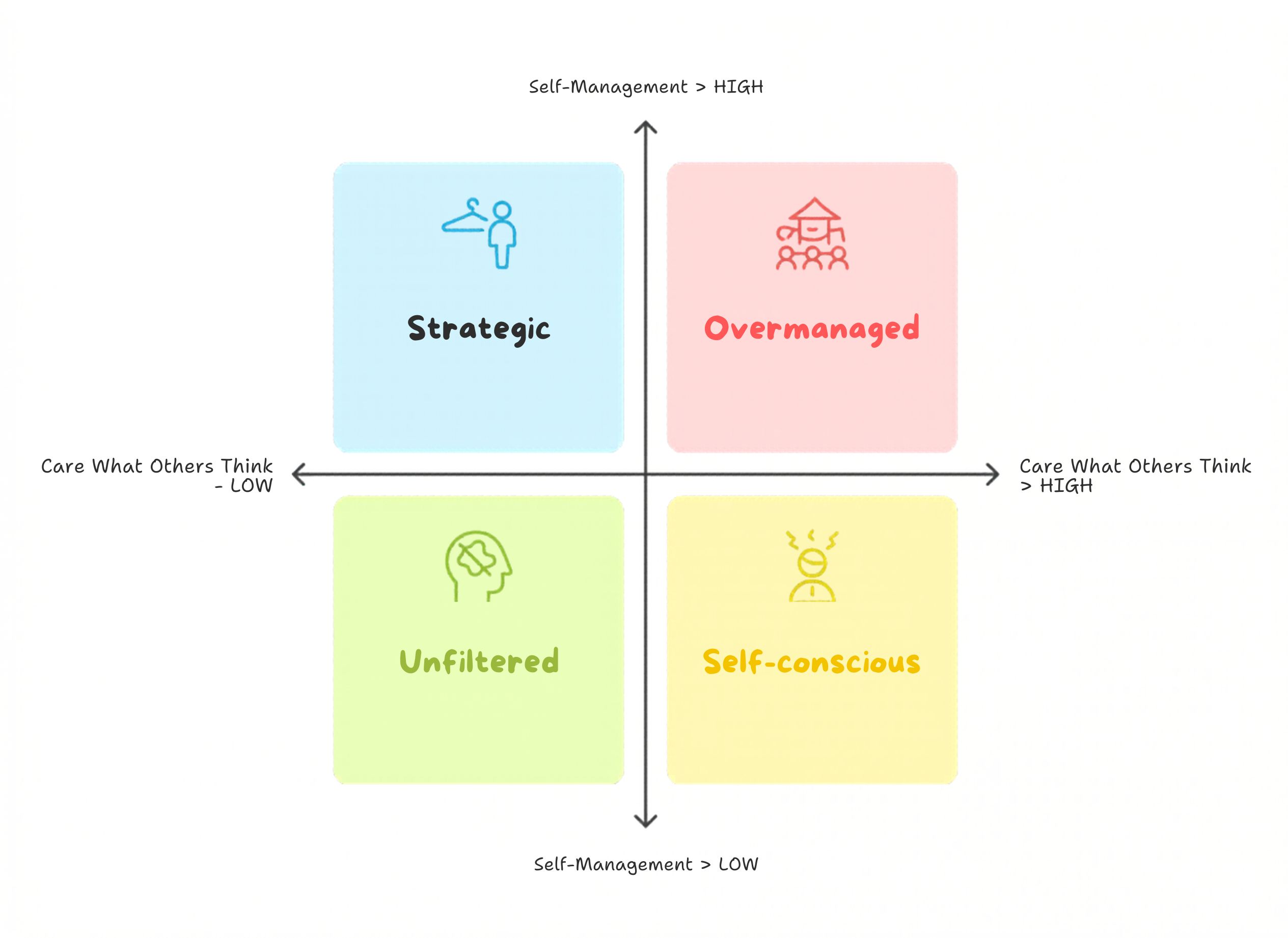
Later, psychologists Mark Leary and Robin Kowalski built on this idea. (Because the concept has developed across both sociology and psychology, it is quite a well-known idea.) Leary and Kowalski identified two aspects of impression management: how much you care about what others think, and how you go about influencing that impression.
This distinction is useful because it helps explain behaviours that might otherwise seem baffling. For example, why someone goes quiet in one room and holds court in another, why they overshare with strangers, or why they come across as ‘pick-me’ when really they’re actually feeling insecure.
Impression management helps us understand these behaviours. People aren’t always being fake when they act differently in various situations. They are often responding to pressure, the audience, and potential consequences.
Real-life examples
You go to a job interview and become your most shiny-shoed, articulate self; you sit up straighter, choose your words more carefully. You don’t bring up your political affiliations or your haemorrhoids.
Obvious, but definitely impression management.
You meet your partner’s friends for the first time and suddenly feel slightly more aware of your laugh, your clothes, and whether your anecdotes make you sound utterly charming or unhinged.
Again, impression management.
You are in a work meeting and make sure your team update sounds competent, calm, and under control, even if you were up till 2am prepping, and inside you are at the extreme end of winging it.
Absolutely impression management.
Online, we practically expect it.
People choose profile pictures, captions, timing, topics, and tone of voice to look sexy, successful, or erudite. They present a version of themselves that they hope will land a certain way. That doesn’t mean they are being deceptive or catfishing. They are just editing, selecting, and arranging. Humans do this all the time, online and off.
And we know this.
Online, you get more time to think about your presentation. You become curator, director, and editor of your persona. That makes the process feel more deliberate. For some, it becomes exhausting because each round of curation widens the gap between who they are and who they present.
In a world of online influencers, AI presenters, and celebrities who seem to age backwards, viewing things through an impression-management lens can be a form of mental self-defence.
Why it matters
Understanding impression management means recognising the difference. There is a gap between trying your best and running yourself into the ground trying to control every last detail of how you come across.
It also helps to turn the lens outwards. Everyone you meet is doing the same thing. So you rarely see the full behind-the-scenes picture of anyone. What you get is their showreel—none of the haemorrhoids, tripping over, or faux pas. Knowing that tends to make you more reflective and less judgmental.
Some impression management is incredibly useful.
It helps us be professional, tactful, reassuring, and appropriate. Impression management keeps things moving and stops us from being too weird. It would be strange if everyone spoke to their boss, dentist, neighbour, and best friend in the same way.
It also helps us be charming, witty, attractive and mysterious.
If that’s what we want.
Too much can leave you tense, over-edited, and disconnected from yourself. Too little can make life more awkward than it needs to be. A certain amount is just a social skill. The trouble starts when you stop just oiling the wheels and start drifting away from your authentic self altogether.
It also helps explain behaviour patterns that can otherwise seem inconsistent:
Why do we care deeply about one group’s opinion and not another’s?
Why do we feel more articulate in some rooms, but can’t get our words out in others?
Why do confident people become oddly self-conscious when the stakes feel high?
This can skew people’s self-perception and make them unfairly self-critical. They tell themselves they are socially awkward, lacking confidence, or not up to the job.
In reality, the stakes are high, and they are working at full capacity just to seem normal.
Try this today
Notice one situation when you feel more managed than usual. A meeting, a social event, a message, a class, a date, a family gathering.
Ask yourself:
- What impression am I trying to create?
- What do I want people to think about me?
- What aspects of myself am I trying to play down?
- Is all of this about professionalism and politeness, or is it just making me tense?
Does this feel like a polished version of me, or a version built mainly to avoid judgement – and who, exactly, am I trying to convince?
Optional challenge
For the next few days, notice the ‘impression’ or self-expression you tend to default to most easily.
Are you the competent one? The easy-going one? The busy one? The do-anything-for-anyone one? The laid-back or the expert one?
Not to judge it, just to watch how you operate.
Then pick one setting where you could be slightly less polished and more authentically yourself.
Dare yourself to be a smidge less curated than usual and see what happens. How are you received? Perhaps go out without makeup (or your grooming equivalent), speak off the cuff, or do whatever feels slightly exposed to you.
You might find the room is less of a bushtucker trial than you thought.
A Buddh-ish take
“As a solid rock is not shaken by the wind, so the wise are not moved by praise or blame.” Dhammapada, verse 81.
Much impression management is simply about seeking approval and avoiding disapproval. Our brains are wired for it. But it can get tiring if every room feels like an assessment or audition.
Present yourself well, certainly.
Be thoughtful, speak clearly, and make an effort.
Of course.
But there is something liberating about not needing every audience to confirm who you are.
If you’re not sure where to start, try taking one small step: the next time you notice yourself seeking extra approval, pause and ask yourself: “What would I think about this in five years’ time?”
Let yourself be just a little less polished in a low-stakes setting, like sharing an honest opinion or not overexplaining a decision. Notice how this feels compared to the usual pressure to appear perfect, and constantly ‘on’.
Notice how it feels when nothing dramatic happens. Gradually, these little experiments help you care a little less about constant external validation.
Still caring, just a little less compulsively.
Back to Mindset Mechanics <
Back to The Vault <