
Learned Helplessness
>Learned Helplessness
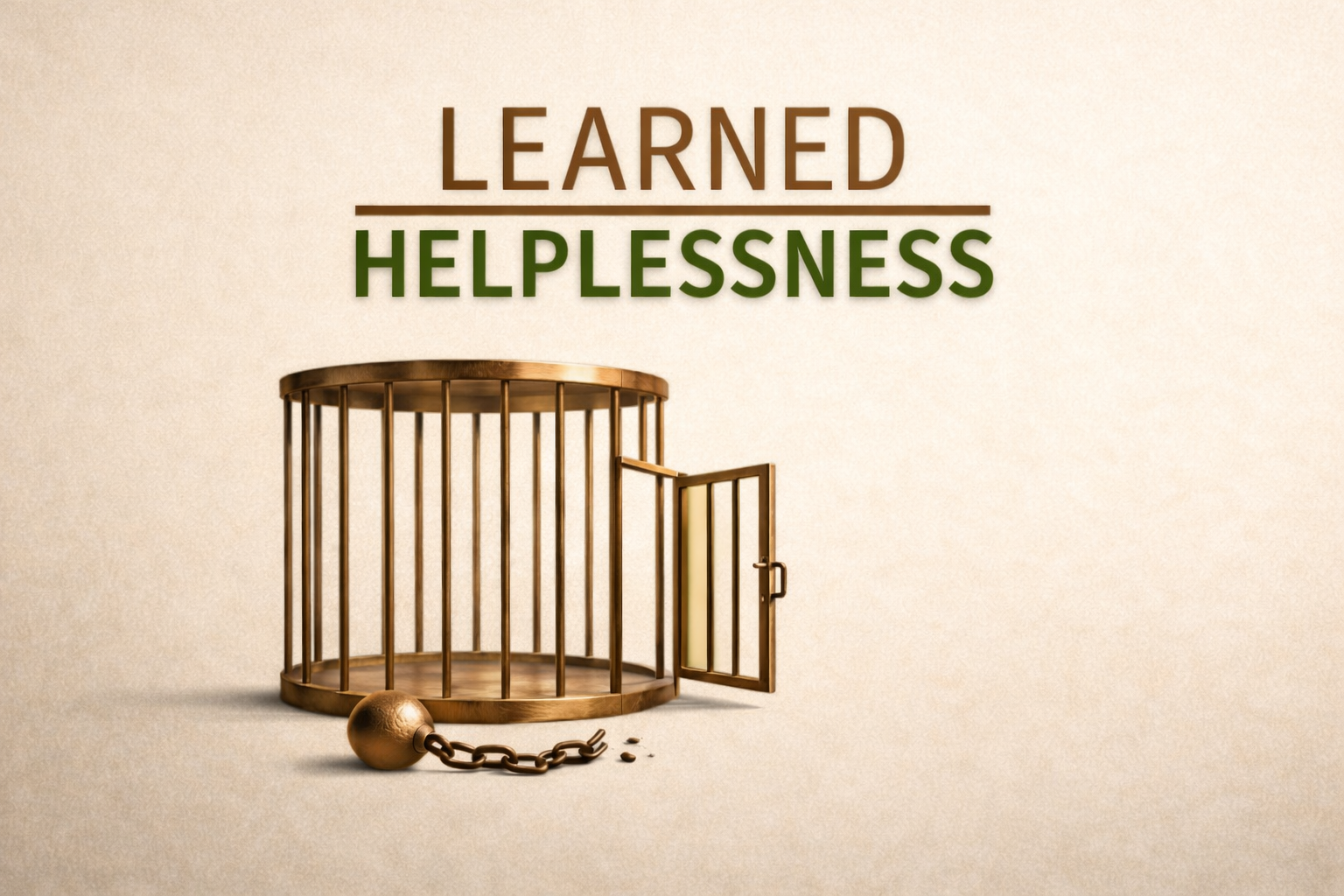
Learned helplessness is a mental state that develops when someone goes through repeated painful or stressful events they can’t control, and starts to believe nothing they do will make a difference – even when it actually could.
This causes them to give up, lose motivation, and feel hopeless – and these feelings can persist long after their situation improves.
But there is another, more everyday version that is far more common and less obvious. This is not necessarily where someone is physically trapped or completely powerless, but where they have simply learned that their efforts don’t seem to change anything.
What it is – and why it’s useful
Learned helplessness is a recognised psychological concept first described by psychologist Martin Seligman in the late 1960s.
The original experiments are now famous, although as an animal lover, I find them pretty disturbing to read about.
Essentially, laboratory animals (dogs, mice, rats) were subjected to conditions where they had no control over an unpleasant outcome.
Over time, after repeated shocks to their little paws with no way to escape, (grr), something interesting happened.
Even when conditions changed, and escape became possible, many of the animals didn’t even try. Nothing was physically stopping them; they simply stopped believing that there was any point in trying. That sentence was sad to type.
These experiments would not meet modern ethical standards in their original form, but they were foundational in shaping how psychologists understand perceived control, motivation and later, aspects of depression.
Later human experiments involved unsolvable puzzles and loud, unpleasant sounds rather than electric shocks. But even then, participants exposed to ‘uncontrollable’ conditions were more likely to report feeling less capable, give up earlier, and perform worse on later tasks.
The concept is often discussed in fairly heavy terms, usually in the context of trauma, adversity, or situations where people genuinely have had very little control over life outcomes.
At some point, the brain runs a very efficient calculation:
I put in effort > I get no result > I stop bothering.
From that point on, behaviour follows one rule: ‘nothing I do matters, so why try?‘
This skipping of the testing process – the brain’s version of ‘skip intro’ – is how learned helplessness can contribute to conditions like depression.
You stop questioning and act on what experience has already told you. In this case, the biggest obstacle might not be the situation itself, but the story your brain has constructed about it.
Real-life examples
New year’s resolution: get into shape. You go to the gym a few times, do everything you think you are supposed to do, and nothing much seems to change. You feel, look and weigh the same. The gym is inconvenient, uncomfortable and seemingly full of 20-year-old Instagram models.
So you stop.
You decide to move up in the world and apply for more senior roles. Crickets. You don’t even get a reply, let alone any feedback.
After a while, you decide you are “not that kind of person”. Who were you kidding?
You speak up in a meeting, and the office extrovert shuts you down. Again. Possibly inadvertently and not even particularly harshly. But you feel dismissed and overlooked. Next time, you say less. Then less again.
Eventually, you just take notes.
Dry January lasts until the 11th – 4 days earlier than last year.
You decide that self-discipline is not your strength.
None of these situations are fixed, but the conclusions you draw from them can be. And once the conclusion is in place, it can shape your decision-making, your confidence and your behaviour.
You are no longer responding to what is happening but to what happened before, skipping straight to a fatalistic prediction of the future.
And as it turns out, it is annoyingly easy to train yourself out of trying.
Why it matters
The usable part of learned helplessness is not in the original experiment, but in recognising the pattern in yourself.
Our brains are designed to conserve effort. If something appears not to work, is painful, or is just too much effort for the return, it stops investing energy in it.
Not enough emotional bang for your buck.
Most of the time, that is helpful. It stops you from repeatedly touching the same hot oven or banging your head against the same metaphorical (or actual) brick walls.
But it also means that even when your circumstances change, your behaviour doesn’t automatically update. You can end up stuck in a situation that is no longer actually stuck.
That is where the more everyday version of learned helplessness becomes relevant. It might look like:
• trying once and stopping
• assuming a negative outcome in advance
• opting out of something you want, to avoid disappointment
It often feels sensible – rational, even. “I’ve tried that before.” “That doesn’t work for me.” “There’s no point.”
All of which might once have been true, but not necessarily true any more.
The practical point here is important. Learned helplessness isn’t a lack of intelligence, courage or ability. It is that your brain has formed a rule based on past data, and is now applying it automatically. If anything, it’s slightly misplaced efficiency.
If the rule is wrong or outdated, the behaviour that follows will be too, logically. And because behaviour affects results, the pattern can reinforce itself.
Less effort > fewer results > confirmation of the original belief.
Round and round.
Argh.
A note on the research
Seligman’s early work did not stop with animals; later studies explored similar patterns in humans. (Thankfully, without the electric shock treatment.)
In one well-known experiment, participants were exposed to unpleasant noise that they initially could not control. Some were able to stop the noise by pressing a button. Others were not, regardless of what they did.
Later, when all participants were given a way to stop the noise, those who had previously experienced control used it quickly.
Those who had learned that nothing worked were far less likely to try, even though the solution was right in front of them. They had internalised a fact that was no longer true.
Subsequent research expanded the idea, showing that the key factor was not just the experience itself, but how it was interpreted.
People who saw setbacks as:
• temporary
• specific
• changeable
People in the first group were far less likely to develop helpless patterns of behaviour (see also Locus of Control).
By contrast, those who saw them as:
• permanent
• personal
• pervasive
(those in the second group), were more likely to stop trying altogether.
Same event, different conclusions and very different outcomes.
Try this today
Pick one area of your life where you feel you may have taken your foot off the accelerator.
Not necessarily given up altogether, but where you have eased off or stopped trying as hard as you have in the past. It could be something you have already decided, perhaps without realising, is not worth the energy.
Ask yourself a slightly uncomfortable question:
Is this actually not worth my energy – or have I just decided it isn’t?
Then test it in a small way.
Send the email.
Ask the question.
Put in the request.
The aim is not instant success (although if you get it – hurrah!), but to update the data your brain is working from.
Optional challenge
For the next week, notice the moments where your inner voice says: “There’s no point.” Try not to argue with it, but notice it – then run a small experiment.
Give it another whirl, including a little tweak or adjustment. Change the approach slightly. Record what happens. You are not trying to force a result, but to test whether the rule still holds.
Often, what once seemed set in stone isn’t quite as solid as we thought. The situation may not have been as fixed as it felt.
Find out whether what was holding you back was the situation – or just your conclusion about it.
A Buddh-ish take
“Oneself is one’s own protector; what other protector could there be?
With oneself well-trained, one gains a protector hard to find.”
– Dhammapada
It’s a slightly uncomfortable idea because it removes the sense that something outside ourselves needs to change first.
Learned helplessness feeds on the belief that effort makes no difference. The quote points in the other direction.
The shift begins with what you do next.
The word ‘protector’ here is not really about safety. It is closer to self-trust. The part of you that tests the rule again instead of following it automatically.
It keeps the possibility of success alive, without any guarantees.
Simply by trying again.
Back to Mindset Mechanics <
Back to The Vault <