
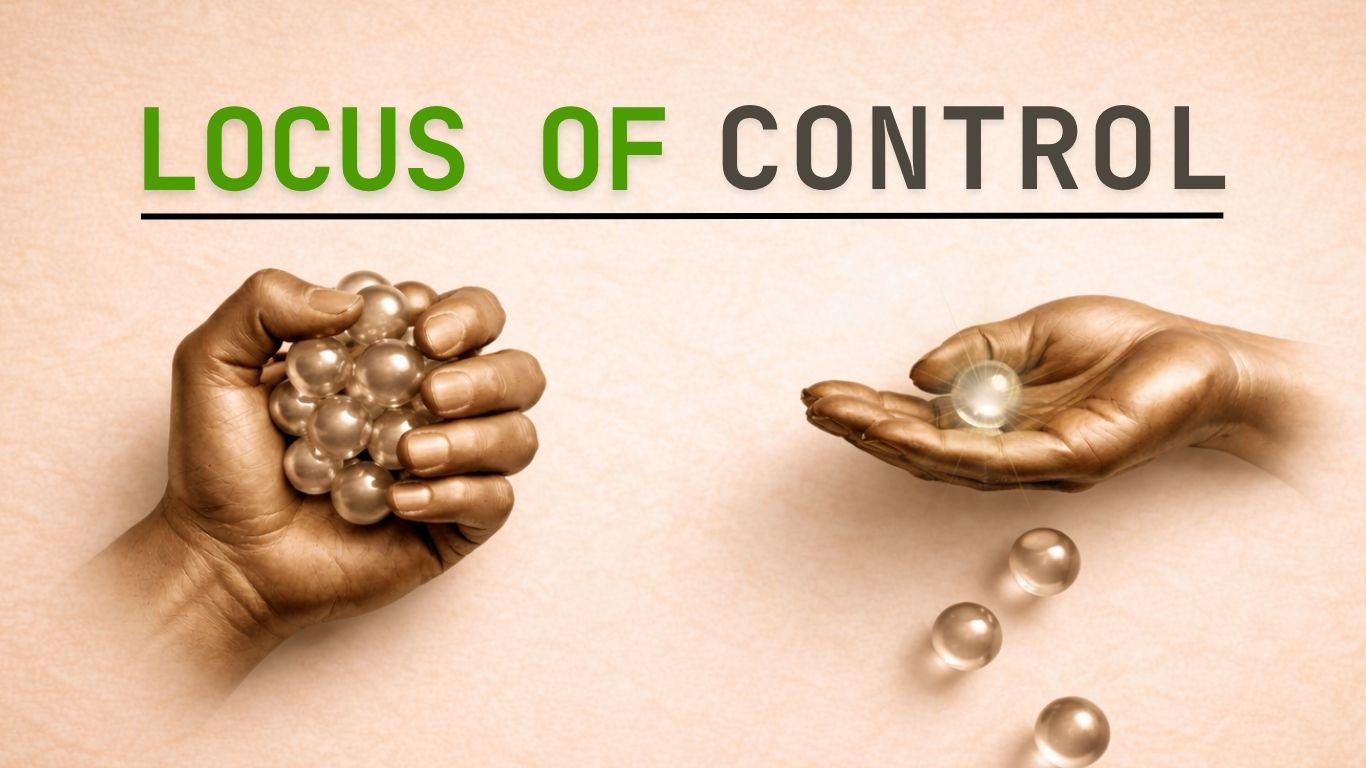
Locus of Control
What it is – and why it’s useful
Locus – where control is placed
Control – the ability to influence what happens
The word locus derives from Latin and means “place” or “position.” So your locus of control is really about where you place control in your mind.
The term comes from psychologist Julian Rotter, who introduced it in the 1950s and 1960s. His social learning theory argued that our behaviour is determined not only by what happens to us but also by what we expect our actions will lead to.
When something happens in people’s lives – especially if it’s significant or important – they tend to attribute it either to themselves (that was my call, my effort, my mistake, my bad) or to something outside them (e.g. timing, other people, fate, a difficult childhood, circumstances, the patriarchy, capitalism).
Rotter explained it in terms of expectancy.
If someone generally expects their actions to affect what happens next, they have a stronger internal locus of control. If they generally expect outcomes to be driven by forces outside themselves, they lean more towards an external one.
It is also worth saying that this is not a neat sorting hat.
Locus of control is more of a continuum, and people can vary by context. Someone may feel as though they have complete agency in their work, that relationships are the luck of the draw, have their dad’s pot belly genes, and are weirdly fatalistic about finances.
It’s useful to get to grips with, because our locus of control doesn’t just shape how we think about our lives, but also how we operate within them: our motivation, our sense of responsibility, how much we take on, how quickly we give up on something, and whether we step up and take the reins.
For example, imagine you miss a deadline at work. Your reaction might be:
“I should have managed my time better and started sooner,”
or
“The final deadline wasn’t that clear, and other people were late too.”
Both perspectives might be true, but the one you choose can affect whether you take action to improve things next time or decide that it’s out of your hands.
What gets more interesting is that the internal is not automatically wise, and the external is not automatically lazy or foolish.
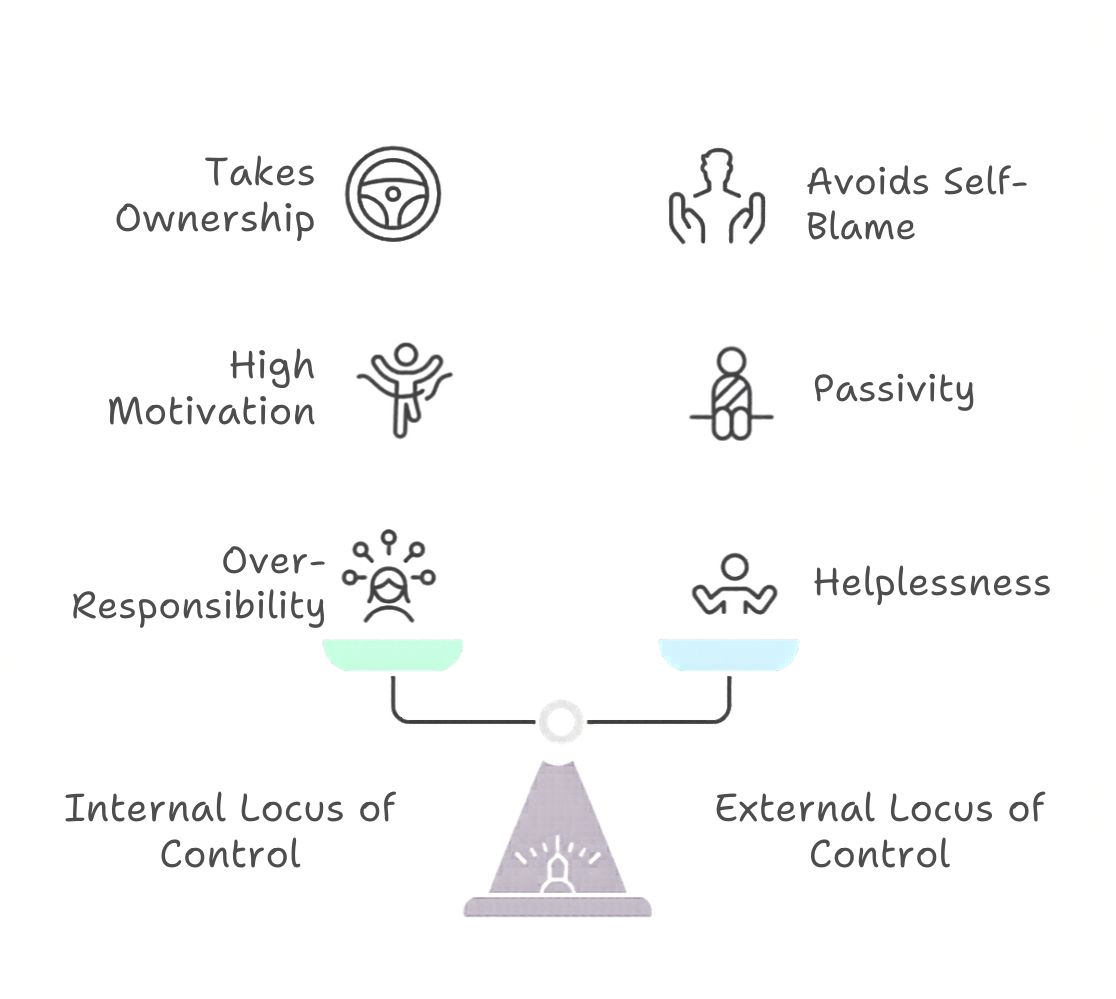
A stronger internal locus can help people feel more in charge, take ownership, and crack on with what needs to be done. It can also tip into over-responsibility, self-blame, and a rather exhausting belief that with enough effort, you ought to be able to manage the economy, your partner’s moods, your child’s GCSEs, and the behaviour of every difficult person in a five-mile radius.
An external locus of control can protect people from unfair self-flagellation when things are genuinely outside their control. However, taken too far, it can slide into passivity, helplessness (see Learned Helplessness), blame, or the feeling that life is happening to you.
So the useful question is not, “Should I have more of an internal or external locus of control?” It is, “Am I placing responsibility accurately?” That is a much better question, and usually a much kinder one.
A simple way to check this in daily life is to pause and ask yourself, “Which part of this is genuinely mine to handle, and which part belongs to someone or something else?” Try running this quick mental check the next time you feel stuck, overwhelmed, or start playing the blame game.
Real-life examples
Imagine two people who do not get the promotion they wanted.
One thinks, “Right, that smarted, but I’ll work on the feedback and improve my chances next time.”
The other thinks, “There was no point trying. It was political from the start.”
Both may contain some truth. Your colleagues likely have agendas and egos. But the first response is more likely to help you move forward. The second is more likely to make you give up.
In health, one person thinks, “I can’t control everything, but I can sort my sleep, move more, keep my appointments, and eat a bit better.” Another thinks, “There’s no point. A little of what you fancy does you good, and I never stick at things anyway.” The first is more likely to actually change something.
It works with relationships, too. Someone with a heavily internal locus of control tendency may think,
“If I explain this better, buy them nicer things, organise things better, maybe this whole dynamic will improve.”
Sometimes that is maturity. Sometimes it means taking responsibility for another adult’s behaviour, or flogging a dead horse.
Someone with a more accurate lens eventually notices, “I’ll do my bit, but they also have to do theirs.”
When we are overwhelmed, locus of control becomes a practical idea; we can take those misfiled responsibilities that have been piling up and start to put them in the right places. One way to do this is to pause for a moment and mentally list what is actually under your control and what is not. Imagine sorting your worries into three mental folders: ‘my responsibility,’ ‘my influence,’ and ‘not mine.’ For each thing that is weighing on you, ask yourself which folder it belongs in. By doing this mental exercise, you reassign what you have mistakenly been carrying and focus on what is truly yours to handle.
Ideally, your concern is reserved for what you can directly influence. Everything else, what is uncertain or belongs to someone else, needs to be mentally parked.
Why it matters
A poorly calibrated locus of control can make life harder from both directions.
When people lean too far toward the external, they become less likely to act, less likely to prepare, and more likely to hand power over to luck, timing, horoscopes, difficult people, bad systems, or random circumstances.
When people lean too far internally, the problem is harder to diagnose from the outside. They often appear capable, conscientious, and responsible. We like that stuff.
But under the bonnet, it can mean chronic self-blame, trouble switching off, and the low-key assumption that if something went wrong, they must have failed to prevent it. The burden of the world – climate change, neighbourhood litter, and world politics are all on their superhero to-do list.
So the healthiest version is neither total internal nor total externality.
It is being able to sort life into sensible categories: what I control, what I can influence, what I can change, and what I need to stop carrying.
Our behaviour is guided by our interpretation of events.
It isn’t a case of being more controlling or easygoing. It’s about becoming more accurate about what is actually yours to carry and what is not.
Then you can save your energy for what you actually can control. It saves a great deal of emotional wear and tear.
Try this today
Pnrfick one situation that is taking up more headspace than it deserves.
Write it down.
Then sort it into three headings:
What is in my control?
My actions, my effort, my preparation, my communication, my boundaries, my next move.
What is within my influence?
Conversations I can have, support I can ask for, options I can explore, requests I can make.
What is outside my control?
Other people’s choices, the past, timing, uncertainty, wider events, and any dramatic Season 5 subplots your mind has written to explain things.
This is not about becoming passive. It is about becoming laser-focused with your attention. Once things are properly filtered, the action becomes clearer, and relief almost always follows.
Some things to think about
Notice the language you use when things go wrong.
Do you tend to say things, at least internally, like:
“They made me feel…”
“There’s nothing I can do…”
“That’s just my luck…”
“It was never going to work…”
Or do you sometimes overshoot?:
“This is all on me…”
“I should have known better…”
“I should have been more persuasive…”
“I need to try harder…”
Neither extreme is especially wise. One gives away power too easily. The other hoards responsibility as if you are personally responsible for holding the world together.
It is also worth remembering that our locus of control is often influenced by our previous experiences. It is not a moral ranking or a personality flaw; it is a pattern of tendencies. The useful thing about that is that patterns can be updated.
Optional challenge
For a week, notice whether you mentally file something in an unhelpful place.
When you notice a thought like, “I have got to sort all of this out,” pause and ask whether it actually has to be you, or whether other people should be involved.
When you notice a thought like, “There’s no point trying,” try to rewrite it more accurately.
“I am responsible for everything, because…”
“There’s nothing I can do, because…”
More accurately, it could be:
“I am responsible for my part, which is…”
“And they are responsible for theirs, which is…”
That is usually closer to reality, and means everyone is actually pulling their weight.
A Buddh-ish Take
The Dhammapada has a lovely quote for this: “You yourselves must strive; the Buddhas only point the way.”
Locus of control is not about pretending you can command all things and every outcome.
It is about recognising that, beyond a certain point, nobody else can do your noticing, your choosing, your effort, or your response for you.
Other people can advise, support, guide, warn, teach, and occasionally be a pain in the bum. But they cannot do your part for you, and you are not supposed to do theirs.
Back to Mindset Mechanics <
Back to The Vault <