
Opportunity Cost
What it is – and why it’s useful
Opportunity cost is one of the simplest ideas in economics.
Whenever you choose one option, you automatically give up the alternatives you did not choose.
Those alternatives are the opportunity cost.
The term was formalised in the late nineteenth century by the Austrian economist Friedrich von Wieser. Earlier economists had described similar trade-offs, but Wieser gave the idea its modern framing.
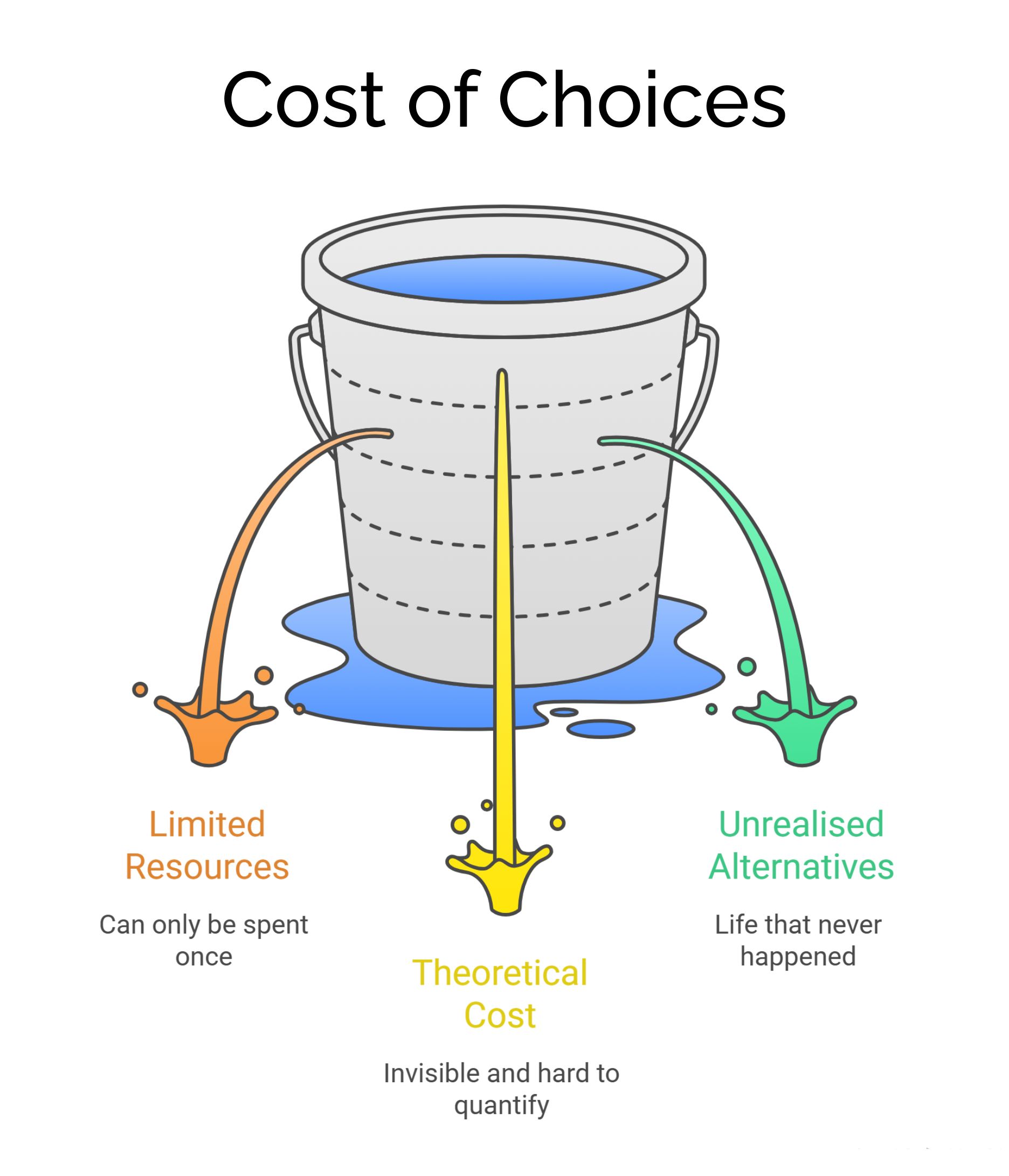
Economists use it as a regular sense-check based on the fundamental premise that resources are limited.
Time, attention, energy and money can only be applied, or spent, once.
The reason the idea is so powerful is that the spent cost is theoretical, invisible even.
If you spend £40 in Marks & Spencers, the receipt tells you about the punnets of strawberries and tubs of cream you’re taking home with your bottle of Cava.
What it does not show is what that £40 might otherwise have been swapped for.
Tickets to see the latest cinema blockbuster. A train ticket to somewhere interesting. A month’s gym membership. Two books you might still be thinking about in ten years.
The opportunity cost is the forty pounds worth of alternative life that never happened, and because it never happened, we find it hard to quantify.
I have been on three game shows over the years (five star, highly recommended).
Anyone who has watched one will recognise the moment when the perky, variably perma-tanned host leans in and offers the final choice.
“You can walk away with what you have already won – it’s a lovely amount, you’ve done so well.”
Or… you can gamble it for something bigger.
Cue dramatic music, audience gasp and camera zoom.
What they are really presenting is a camp, theatrical but perfect example of opportunity cost.
Take the safe prize and you give up the possibility of the bigger one.
Go for the bigger one and you’ve lost the certainty of what you already have.
You’re choosing between:
“Well, I’ve had a lovely day, I’ve met some great people and I’m leaving with more than I came with, so I will take what I’ve won already.”
(Pretty great.)
and the possibility of:
“OH NO, I’M SO SORRY THAT’S THE WRONG ANSWER, you’re down to zero – but look at what you would have won!”
or
“CONGRATULATIONS, THAT’S THE CORRECT ANSWER – YOU’RE A WINNER!!”
and the crowd go wild.
You go down one road, and the others vanish behind you.
Every decision works like that. Each choice you make replaces and updates future possibilities. Opportunity cost is the name economists gave to the not-chosen alternatives.
p.s. won one game show, finalist in another, out in the first round the third.
Real-life examples
Imagine someone spends most of a Saturday reorganising their email inbox. Messages neatly sorted, folders colour-coded, the digital equivalent of sorting out under the stairs.
Productive.
The opportunity cost of those hours might have been finishing a project, going for a long walk, seeing a friend, or having a much-needed nap.
The activity itself may be a perfectly sensible use of your time, but the alternatives don’t make the spreadsheet.
You see the same pattern in business decisions.
A company might spend years refining an existing product because so much effort and investment have already gone into it. On pape,r that can look sensible. (See also: Sunk Cost Fallacy.)
The opportunity cost could be the creative new innovation, or up-to-date market research, or new sales opportunities that are never explored because attention stays fixed on the familiar path.
Time is the mother of non-renewable resources.
Agreeing to yet another committee meeting about the same subject might replace an hour of focused thinking and decision-making that could happen in that hour.
Scrolling through a phone for an hour replaces whatever else that hour could have been.
Taken individually, opportunity cost might not be too significant, but over weeks and months, it shapes the direction of your life.
Career decisions often contain the largest opportunity costs of all.
Someone may choose a profession because it feels secure, respectable or expected. There’s good money in it, a job for life. The salary arrives, the title sounds impressive, and the path is predictable.
Happy days.
But ten years down the road, the opportunity cost might be an entirely different direction that would have suited their talents better. (Going to be much more difficult to be a bass guitarist in a sell-out stadium band now.)
The chosen path becomes visible. The other possibilities fade into the ether.
Attention works in exactly the same way. If most of your mental diet consists of outrage, breaking news, and algorithm-curated rabbit holes of distraction, the opportunity cost is depth.
Books not read. Ideas not explored. Meals not enjoyed. Conversations not had.
Opportunity cost rarely announces itself at the time. It simply accumulates in the rear-view mirror of hindsight.
Why it matters
Understanding opportunity cost changes how you look at decisions. Most people evaluate choices by asking a simple question.
“What will I gain from this? What’s in it for me?”
Opportunity cost asks a slightly different one.
“What will this replace?”
The difference is subtle but important. A decision that looks attractive on its own can look very different when the possible alternatives are placed beside it. It also demonstrates that time can be more valuable than money.
Money can sometimes be replaced: a windfall, a bet, an investment, income, a gift. Time cannot. An hour spent somewhere is an hour permanently unavailable for everything else.
This does not mean every decision needs to become an elaborate calculation. Life would become exhausting very quickly if we tried to optimise every moment.
The value of the idea is simply that it widens our view.
Instead of looking only at the option in front of you, you briefly consider the other paths that exist alongside it.
Sometimes that confirms that your choice is exactly right. Other times it reveals that what looked like a harmless “yes” is at the expense of something that means more to you.
Once you see opportunity cost clearly, priorities tend to reorganise themselves.
Try this today
The next time you are deciding how to spend your time or money, pause for a moment and ask one extra question.
“What else could this become?”
If you are about to spend an evening scrolling TikTok, could a tutorial or online course on something you’ve always wanted to learn occupy that same time?
If you are about to buy something impulsively (you’ve got to treat yourself, right?), what other experience that money might create?
You do not need to choose the alternative every time. The point is to see that alternatives exist.
Some things to think about
- Where in your life might the opportunity cost of your habits be higher than you realise?
- Are there activities that feel harmless in isolation but expensive (in time, money, energy) when viewed over a year?
- What could become possible when you protect time for the things that matter most to you?
- Are your choices deliberate, or is convenience trumping your longer-term goals?
Optional challenge
For one week, treat your time as though it were spendable currency. We use this exercise in our time management course, and it reliably produces mic-drop moments.
Imagine your hourly rate is £100 an hour (why be cheap?). That gives you £2400 to spend each day. £800 of it disappears immediately on sleep. Then subtract non-negotiables: work, travel, cooking, cleaning, ablutions.
What’s left is your real budget.
Each time you commit to something, it has to come out of what remains. Not to judge the decision, simply to see the trade-off. Most people discover that the real constraint in life is not opportunity.
It is attention and focus.
A Buddh-ish take
“By oneself is evil done; by oneself is one defiled. By oneself is evil left undone; by oneself is purified. Purity and impurity depend on oneself.”
– Dhammapada
Buddhist philosophy often returns to the idea that each action shapes what comes next. Each choice sends life down one path whilst invisibly closing others. The wise person looks towards the horizon rather than worrying about the next corner.
Back to Mindset Mechanics <
Back to The Vault <